Africa's safest airlines

By Josh Wood Fri Jun 26, 2026
Africa's aviation industry is now one of the fastest growing in the world, and within it sits a group of airlines whose safety records can be compared with other carriers anywhere on the planet.
The continent's international routes are still dominated by foreign carriers connecting to and from the Middle East, but African airlines are expanding further and more confidently than ever before, and a small group of them have built safety records that stand in comparison with anywhere on the planet.
As the propensity to travel rises across the continent, safety remains the priority for every airline. Carriers including Ethiopian Airlines, Royal Air Maroc and RwandAir lead the field, each holding the Seven Star Safety rating from AirlineRatings.com.
Seven Star national carriers
In the year ending March 2026, African airlines outperformed every other region in terms of growth. Demand climbed just under 20 percent, showing a real demand for travel across the region.
Eastern Africa has the largest growth, mainly thanks to Ethiopian Airlines and its rapid expansion over the past decade and current Vision 2040 plans announced in April 2026.
The following airlines are the safest, Seven Star Safety Rated airlines in Africa, and represent a continental commitment to overall safety. Each airline is registered with IATA’s IOSA programme, has modern and well-maintained aircraft, has minimal pilot-related incidents, is not banned within the European Union and has no operational safety concerns.
Ethiopian Airlines – 158 aircraft with an average age of 9.3 years
Royal Air Maroc – 66 aircraft with an average age of 11.9 years
Kenya Airways – 34 aircraft with an average age of 14.6 years
Air Mauritius – 11 aircraft with an average age of 11 years
Tunisair – 18 aircraft with an average age of 11.3 years
RwandAir – 14 aircraft with an average age of 13.2 years
Air Seychelles – 7 aircraft with an average age of 10 years
FlySafair – 40 aircraft with an average age of 19.4 years
Airlink – 70 aircraft with an average age of 18.4 years
Air Austral – 8 aircraft with an average age of 8.7 years
Air Cairo – 39 aircraft with an average age of 8 years
Cabo Verde Airlines – 4 aircraft with an average age of 10.6 years
Africa’s variable safety history is marked by improvements
Historically, Africa has carried the world’s highest regional accident rate for decades, with the EU’s blacklist being a clear symbol of the problem. At one point, the list featured 91 African airlines across 13 nations.
However, the poor safety record of drivers was structural rather than cultural. Main areas of concern were ageing fleets, under-resourced regulators, insufficient pilot recurrent training, and poor accident reporting. ICAO’s Universal Safety Oversight Audit Programme consistently flagged weak oversight by civil aviation authorities across the continent.
Now, the continent has made significant improvements across the board, and the statistics back this up. Between 2010 and 2013 alone, Africa’s accident rate fell by 45 percent from 16.8 to 9.3 accidents per million departures. Africa continued to improve, and in 2014, the accident rate per million flights fell to 8.4, and by 2020, it was at 3.5. For comparison, Europe’s accident rate for 2020 was 1.37. IATA’s 2023 report recorded the accident rate at 6.38 per million sectors, with zero fatalities and no jet aircraft losses since 2020.
A spike in accidents but zero fatalities in 2024
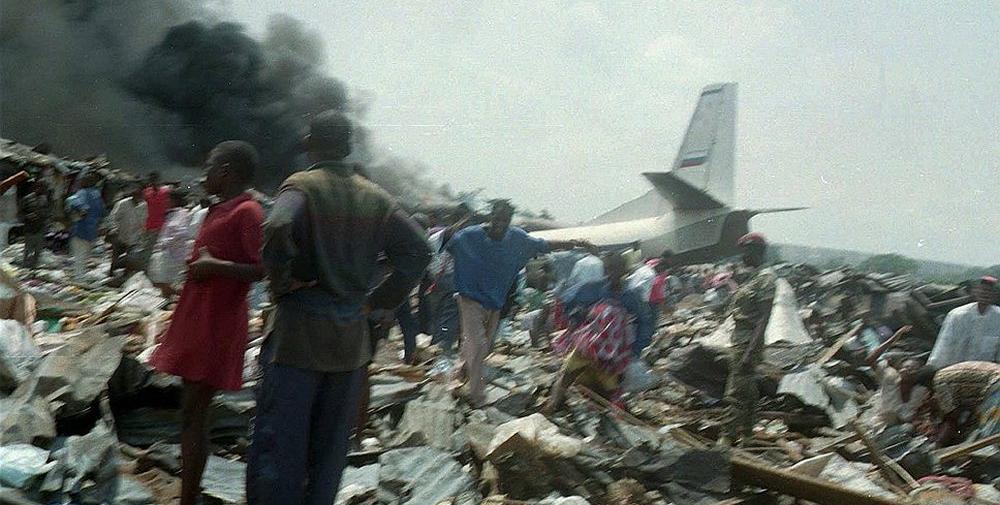
The story slightly changes in 2024 as the overall accident rate increases to 12.13 per million flights across 11 main events, the worst regional figure globally, with runway excursions and landing-gear failures dominating accidents. A Transair Boeing 737-300 operating for Air Senegal veered off the runway in Dakar in May, catching fire and injuring 11 people. Days earlier, a Serve Air cargo 737 suffered a similar excursion in the DRC. In January, an Ethiopian Airlines Dash 8 lost its gear at Mekele. Despite the accident rate rising, none of these caused any fatalities. The fatality risk remained at zero, meaning ageing fleets and weak ground infrastructure rather than a systemic failure.
In 2025, the accident rate dropped back to 7.86 per million flights, below the five-year average of 9.37. However, the fatality risk jumped to 2.19 due to a spike in turboprop accidents that accounted for 71 percent of African operator accidents. Despite the improvement, Africa still sits above the global accident rate average of 1.32 per million flights.
Two structural problems sit behind the headline figures. Average ICAO standards implementation across 46 of 48 Sub-Saharan African states stands at 60.34 percent, against a global target of 75 percent. Only 12 of Africa's 54 states meet that threshold and between 2019 and 2023, just 19 percent of African accident reports met state obligations under the Chicago Convention. The global average sits at 63 percent.
The improvements are real and the trajectory is positive, but the work isn't finished. IATA launched new continent-wide standards under its Collaborative Aviation Safety Improvement Program at the Focus Africa conference in Addis Ababa in April 2026, with initial rollout across roughly 16 states.

A continent of two safety stories
The honest takeaway is that the headline accident numbers for Africa hide two different realities. The continent contains both top-tier and world-class airlines in terms of safety, and carriers that are subject to older fleets and poorer ground infrastructure, that increase the accident trend.
The 12 airlines listed above sit firmly in the first group, with safety records that match those of airlines in Europe, Asia, and North America. As the next phase of Africa’s aviation safety plays out under Focus Africa, these carriers will champion and lead the way. The gap that matters now is no longer between Africa and the rest of the world, but between Africa’s best airlines and the rest of the continent.
Have questions or want to share your thoughts?