Wreck hunter Blaine Gibson upbeat on finding MH370

By Geoffrey Thomas Tue Nov 30, 2021
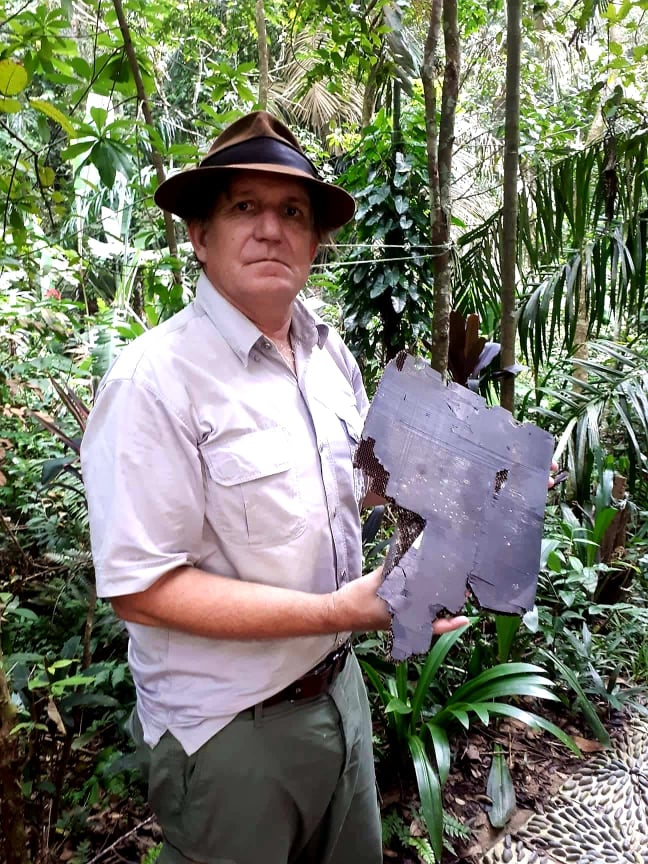
In an exclusive interview wreck hunter Blaine Gibson, who is responsible for finding the most pieces of Mh370 debris discusses Richard Godfrey's new breakthrough technology to locate the Boeing 777 which disappeared on March 8, 2014.
Here are Mr Gibson's thoughts;
"The new Richard Godfrey location of 33°S 95°E is supported by the drift analysis of Prof. Chari Pattiaratchi that accurately predicted the location and timing debris would wash ashore, and directly resulted in the recovery of many pieces of MH 370 debris.
"Richard Godfrey's recommended 40 nm radius search area extends well into Broken Ridge and includes some of the priority recommendation of Prof. Chari around 32°and 33 °S.
"Fugro and Ocean Infinity should review scan data near those coordinates. Richard Godfrey's suggested crash site is only about 75 nautical miles from the location from which Prof. Chari conducted his drift simulations, 32.5°S 96.5°E.
"It fits into the southern edge of his drift analysis and conforms to the debris evidence and oceanography well.
"I make no judgment as to who if anyone was controlling MH 370 and why. My statement is limited to the only physical evidence we have, the debris, and oceanography, and drift analysis. I am a wreck hunter, not a rocket scientist, and am not qualified to judge if WSPR can track MH 370 or not.
READ: MH370 probable location found
READ: MH370 the extraordinary trail of debris across the Indian Ocean
READ: WSPRnet explained
"The best way to verify is to review the scan data and restart the search and see if the plane is there or nearby. If still not found the search should be extended wider to 70 nm wide on both sides of the 7th arc between latitudes 32°S and 33°S as recommended by Prof Chari, and wider in immediately adjacent areas as may be recommended by others.
 "Past searches have relied heavily on Inmarsat data analysis and been welded narrowly to the 7th arc. We need to rely more on oceanography and be prepared to search wider at most likely latitudes. There are many things in the WSPR flight route analysis that are controversial but it is good to be open-minded, try new methods, and think out of the box.
"Most important is the final Point of Impact, and that fits with the strongest evidence of all, the debris and drift analysis. There are many different paths to the same destination. Once we find the underwater wreckage we will learn more about how the plane impacted the water. Hopefully, we can recover the flight data recorder and its data and know more about where it flew before, the who what and how, and perhaps even why."
"Past searches have relied heavily on Inmarsat data analysis and been welded narrowly to the 7th arc. We need to rely more on oceanography and be prepared to search wider at most likely latitudes. There are many things in the WSPR flight route analysis that are controversial but it is good to be open-minded, try new methods, and think out of the box.
"Most important is the final Point of Impact, and that fits with the strongest evidence of all, the debris and drift analysis. There are many different paths to the same destination. Once we find the underwater wreckage we will learn more about how the plane impacted the water. Hopefully, we can recover the flight data recorder and its data and know more about where it flew before, the who what and how, and perhaps even why."

"Past searches have relied heavily on Inmarsat data analysis and been welded narrowly to the 7th arc. We need to rely more on oceanography and be prepared to search wider at most likely latitudes. There are many things in the WSPR flight route analysis that are controversial but it is good to be open-minded, try new methods, and think out of the box.
"Most important is the final Point of Impact, and that fits with the strongest evidence of all, the debris and drift analysis. There are many different paths to the same destination. Once we find the underwater wreckage we will learn more about how the plane impacted the water. Hopefully, we can recover the flight data recorder and its data and know more about where it flew before, the who what and how, and perhaps even why."
Have questions or want to share your thoughts?