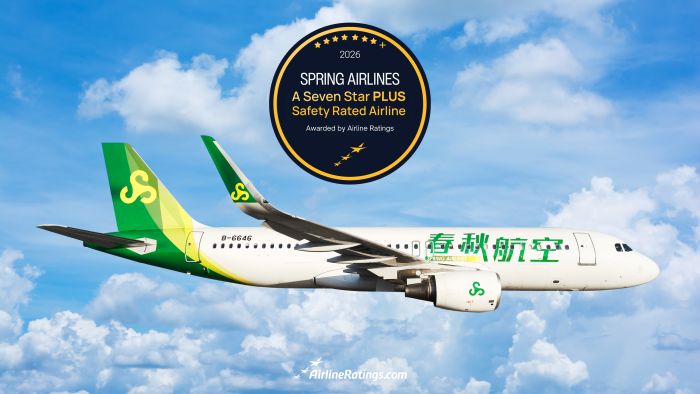
Spring Airlines: China's first seven star PLUS safety rated airline

By Airline Ratings Thu Oct 29, 2026
Spring Airlines has become the first airline in mainland China to earn the AirlineRatings Seven Star PLUS Safety Rating, following an independent onboard cabin safety audit across six of the carrier’s scheduled flights in October.
China’s largest low-cost carrier already held the Seven Star Safety Rating after its first audit in September 2025, and this year’s return audit has earned it the step up to PLUS. The rating is valid for two years, and Spring will need to complete a further audit before it expires to keep the status.
Shanghai based Spring Airlines now sits alongside Cathay Pacific, HK Express, EVA Air and STARLUX as one of the Greater China carriers holding the rating, while becoming the first from the mainland to achieve it.
What the audit covered and what stood out
The audit took place across six flights between 20 and 23 October 2026, covering Spring’s international route between Shanghai and Jeju in South Korea along with domestic services from Shanghai to Chongqing, Shijiazhuang and Jieyang. All flights operated on A320 and A321 aircraft.
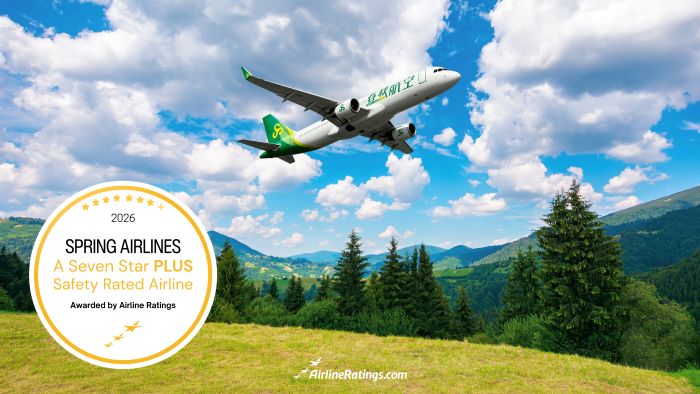
According to Josh Wood, AirlineRatings Safety and Service Quality Manager, who carried out the audit, the first thing you’d notice on a Spring flight is how seriously the crew take the cabin checks before take-off and landing, with two crew members often walking the aisle together to make sure every seatbelt was fastened and every bag stowed properly. That same attention carried through once the aircraft was airborne, because whenever the seatbelt sign came on for turbulence, the crew followed it with an announcement so passengers understood why they needed to sit down.
Power banks got plenty of airtime too. On every flight the crew reminded passengers how to carry and use them safely, which is the kind of messaging airlines need to get right as the industry pays closer attention to lithium batteries in the cabin.
The exit row briefings went further than most. Passengers in those seats received a detailed briefing before departure, and the crew came back before landing to remind them of their responsibilities, a second briefing that very few airlines bother to give.
Even on the busiest sectors the crew stayed calm and in control, and Wood said it was that professionalism that made the difference.
‘Spring Airlines has made impressive progress in onboard safety over the past year, and the professionalism of its cabin crew stood out on every flight. Crews managed busy cabins calmly and kept safety at the centre of everything they did, from detailed exit row briefings to careful pre-departure and pre-landing checks, across both its domestic network and its regional international route. Spring Airlines earns the Seven Star PLUS Safety Rating in recognition of that consistency and the work the entire airline has put in.’
Sharon Petersen, AirlineRatings VP of Airline Partnerships, said Spring’s quick response to the first audit showed what the programme is designed to achieve.
‘Spring is a great example of what our audits can bring to the industry, and ultimately to the passengers and crew who fly with every airline. Spring already held a great safety rating, but there was room for improvement, as there is at every airline. What impresses us so much about Spring is how quickly it made changes and put them into practice, which is what putting safety first looks like, and we applaud the airline for it. Spring ranked 19th in our World’s Safest Low-Cost Airlines for 2026, and its open approach to cabin safety, combined with meticulous processes at a maintenance level, puts it in a strong position to earn a place among the world’s best again in 2027. Congratulations to everyone at Spring Airlines.’
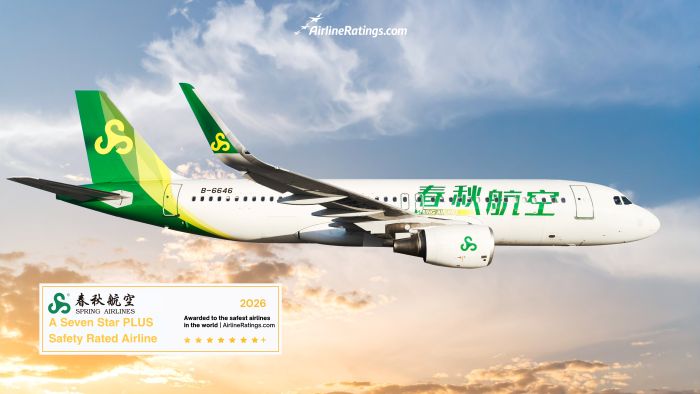
So what does Seven Star PLUS actually mean?
Seven Star PLUS is a safety rating an airline earns, not one it can buy. To be eligible, an airline must already hold our seven star safety rating, the top of our scale. Only then can it put itself forward for the audit that leads to a Seven Star PLUS rating.
The airline invites our auditors aboard for an independent, anonymous assessment of its cabin crew safety compliance, observed under normal flight conditions across six flights. An airline earns Seven Star PLUS only if that audit goes well and stringent standards are met overall. Not every airline that sits it will clear it and a review audit will be conducted within the year. Whilst the airline pays for the service, it does not pay for the result. That distinction matters, because it means the rating reflects what our auditors actually found. An airline with a number of areas for improvement will simply retain their Seven Star safety rating.
The value in these audits sits with both the airline and the passenger. For the airline, the audit catches things early. It finds genuine cabin crew compliance gaps and helps close them before they ever become incidents or regulator findings. A safety team and a CFO both understand the value of catching a problem early. Earning the rating gives the airline a credential that carries weight precisely because it cannot be bought.
For travellers, Seven Star PLUS is a simple signal worth knowing. It marks an airline that already sits at the top of our safety rating, then opened its cabin operation to independent scrutiny and passed.
One thing to be clear about is that an airline without Seven Star PLUS is not unsafe, and it is not ranked below those that hold it. The PLUS indicates a mark of verified cabin safety compliance, earned by the airlines that have chosen to be tested and met the standard.
About Spring Airlines
Founded in Shanghai in 2004, Spring Airlines took to the skies the following year as China’s first low-cost carrier and has since grown into the country’s largest, flying a fleet of more than 140 Airbus A320 family aircraft across its domestic network and short-haul international routes into Japan, South Korea and Southeast Asia. The airline has never had a fatal accident in more than two decades of flying. Spring is set to carry far more passengers in the years ahead while keeping to its all-Airbus fleet.
Have questions or want to share your thoughts?