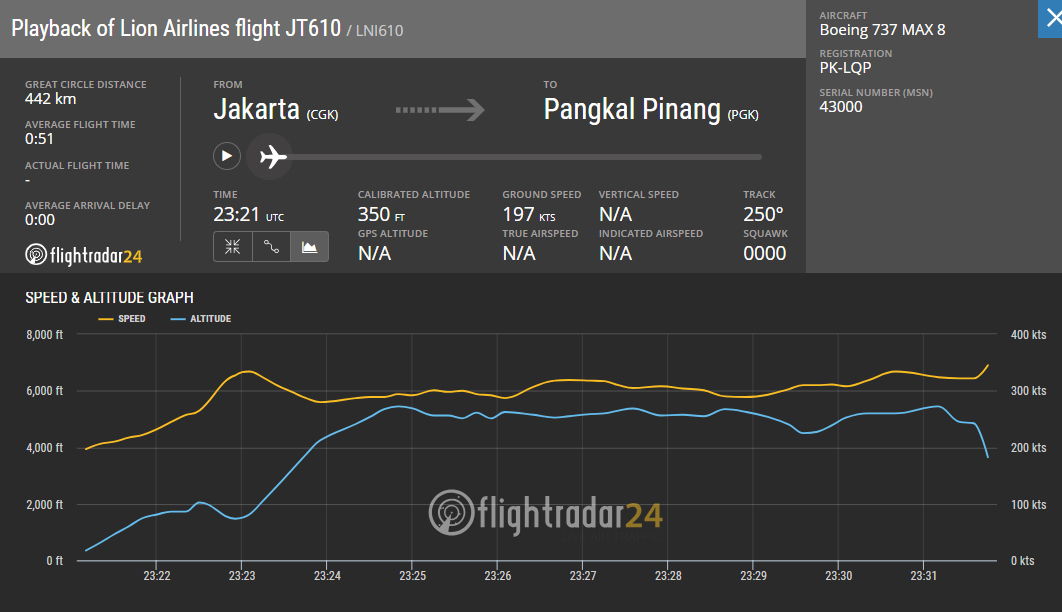

The Lion Air 737 MAX that crashed on Monday, October 29 killing all 189 aboard had serious control problems the day before, similar to those seen just before the flight crashed into the sea.
Lion Air flight JT-610 took off from the Jakarta airport at the 6.21am local time and lost contact at 6.33am.
SEE Our Concorde Special Report
According to Aviation-Safety.net flight, JT610 took off from runway 25L at Soekarno-Hatta Airport at 06:21 hours local time.
"ADS-B data of the flight, captured by Flightradar24 and FlightAware, show erratic values. The aircraft made a climbing left-hand turn after takeoff. Shortly after passing the ADS-B reported altitude of 2100 feet, data points briefly show a lower altitude of around 1475 feet," the website reported.
"Altitude data sent via ADS-B continue to show an erratic pattern, varying roughly between 4500 and 5350 feet, The values then rapidly decline until contact is lost at 06:32 hours."
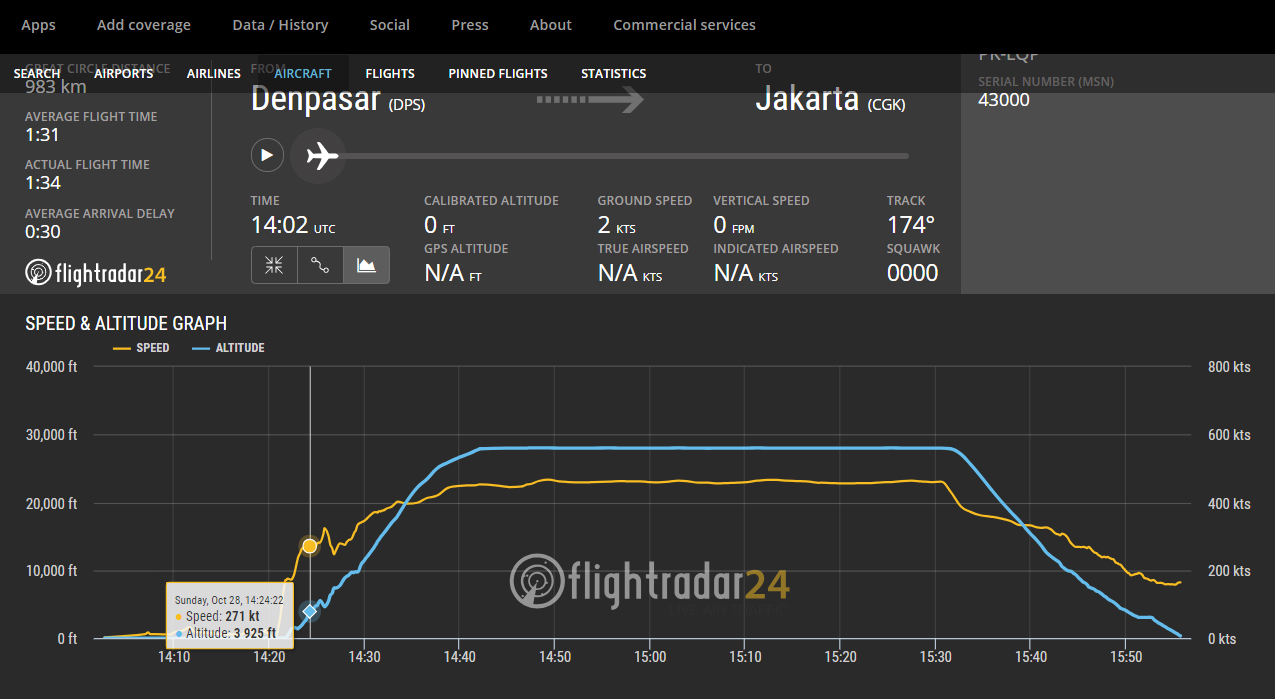
Aviation-Safety.net said that "the previous flight of the accident aircraft, JT043 from Denpasar, showed similar erratic values (BELOW WHERE HIGHLIGHTED) in altitude and airspeed after takeoff. After 8 minutes the values stabilized."
 A log entry cited by AirlineRatings.com shows "airspeed unreliable and alt disagree shown after take off. It adds that the Captain's instrument was unreliable and handover control to FO."
Lion Air has confirmed that the aircraft had a "technical problem" on the previous flight, "which had been resolved according to the procedure.”
The copy of the tech log that is circulating on media apparently shows that the Pitot Tube and Static Port were examined and checked.
Put simply a pitot-static system is a system of pressure-sensitive instruments that are used in aviation to determine an aircraft's airspeed, altitude, and altitude trend.
Lion Air Group chief executive Edward Sirait said the airline could not comment further at this time.
A log entry cited by AirlineRatings.com shows "airspeed unreliable and alt disagree shown after take off. It adds that the Captain's instrument was unreliable and handover control to FO."
Lion Air has confirmed that the aircraft had a "technical problem" on the previous flight, "which had been resolved according to the procedure.”
The copy of the tech log that is circulating on media apparently shows that the Pitot Tube and Static Port were examined and checked.
Put simply a pitot-static system is a system of pressure-sensitive instruments that are used in aviation to determine an aircraft's airspeed, altitude, and altitude trend.
Lion Air Group chief executive Edward Sirait said the airline could not comment further at this time.
A log entry cited by AirlineRatings.com shows "airspeed unreliable and alt disagree shown after take off. It adds that the Captain's instrument was unreliable and handover control to FO."
Lion Air has confirmed that the aircraft had a "technical problem" on the previous flight, "which had been resolved according to the procedure.”
The copy of the tech log that is circulating on media apparently shows that the Pitot Tube and Static Port were examined and checked.
Put simply a pitot-static system is a system of pressure-sensitive instruments that are used in aviation to determine an aircraft's airspeed, altitude, and altitude trend.
Lion Air Group chief executive Edward Sirait said the airline could not comment further at this time.
"We are trying to collect all the information and data," he said.
The last major accident in Indonesia was in December 2014 when an AirAsia Indonesia’s Airbus A320 aircraft crashed into the waters after taking off from Surabaya to Singapore with 162 people on board.
Developing storyHave questions or want to share your thoughts?

.jpg)