The biggest competitor to Qantas domestic business class? Qantas itself.

By Sharon Petersen Thu Sep 3, 2026
For years, the choice for a more comfortable long domestic flight was relatively simple: pay the premium for Business Class or accept the limitations of Economy. Qantas has now complicated that equation with Economy Plus, a product that delivers significantly more space, priority boarding and overhead bin access for considerably less than a Business Class fare.
Having recently flown the new A321XLR in Business Class, we wanted to explore just how wide the gap remains between the two products, while also giving you a closer look at the overall experience onboard Qantas’ newest domestic Business Class product.
The A321XLR has quickly become a familiar sight on Australia’s east coast and across the Nullarbor, with seven aircraft now in service against a firm order for 48. Qantas is using the type to replace its oldest 737-800s under Project Winton, and on routes where the two aircraft still overlap, the difference in the Business Class experience is immediately noticeable to anyone who regularly flies these sectors.
Route: Brisbane – Perth
Seat: 2A
Flight time: 11:05am AEST departure, arriving in Perth at 1:50pm AWST, around 40 minutes ahead of schedule.

The Cabin
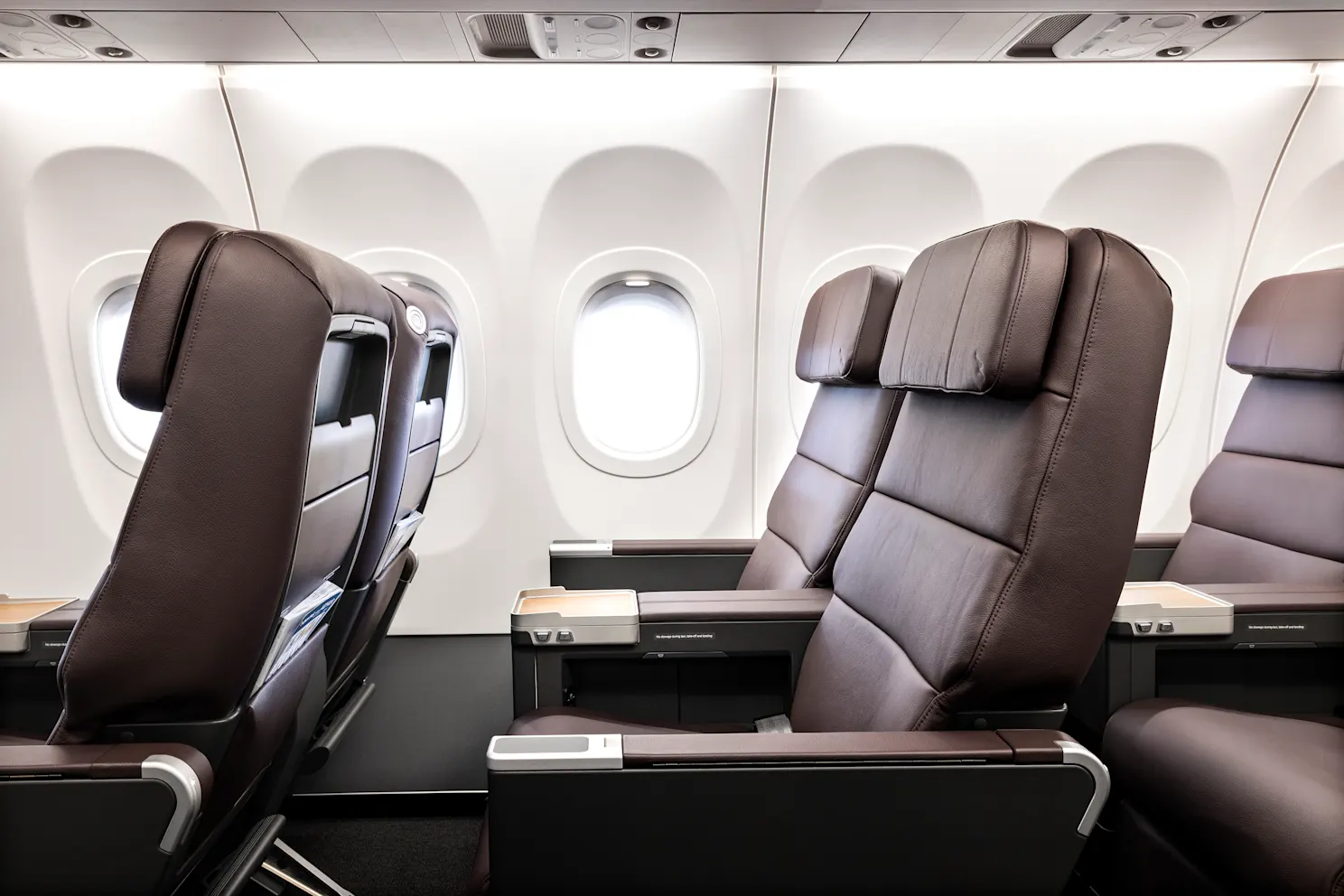
Business occupies five rows in a 2-2 layout, seating 20 passengers ahead of an economy cabin. The aircraft is not only five metres longer than the 737-800, but the A321 fuselage gives Qantas room for a genuinely larger premium space rather than the same product transplanted into a new shell.
The first impression is a bright one. The windows on the A321 are larger than those on the 737, the ceilings sit higher and overhead space comes from the Airspace bins, which take roughly 60 per cent more baggage than the 737 arrangement, and that translates into a boarding process where in theory nobody in Business is hunting for a home for their roller bag ( though I did still need to put mine back in row 5).
The seat
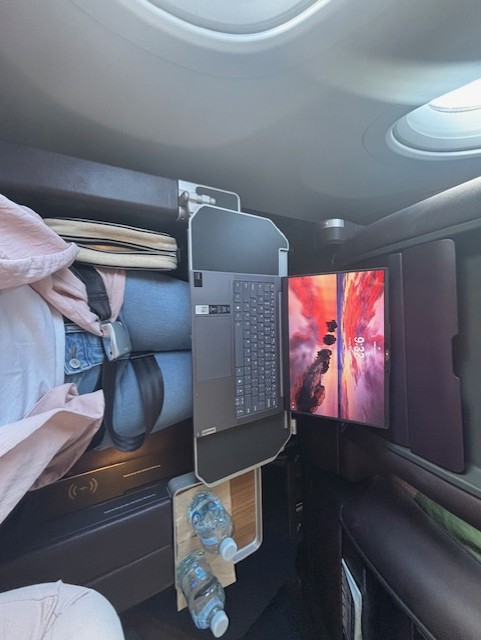
Qantas has fitted a recliner with a 37-inch pitch and a 25-inch (63.5 cm) width, along with a footrest and a leg rest. The measurements put it comfortably ahead of what the 737 offers, and the practical gain shows up in the time you spend working rather than the time you spend trying to get comfortable.
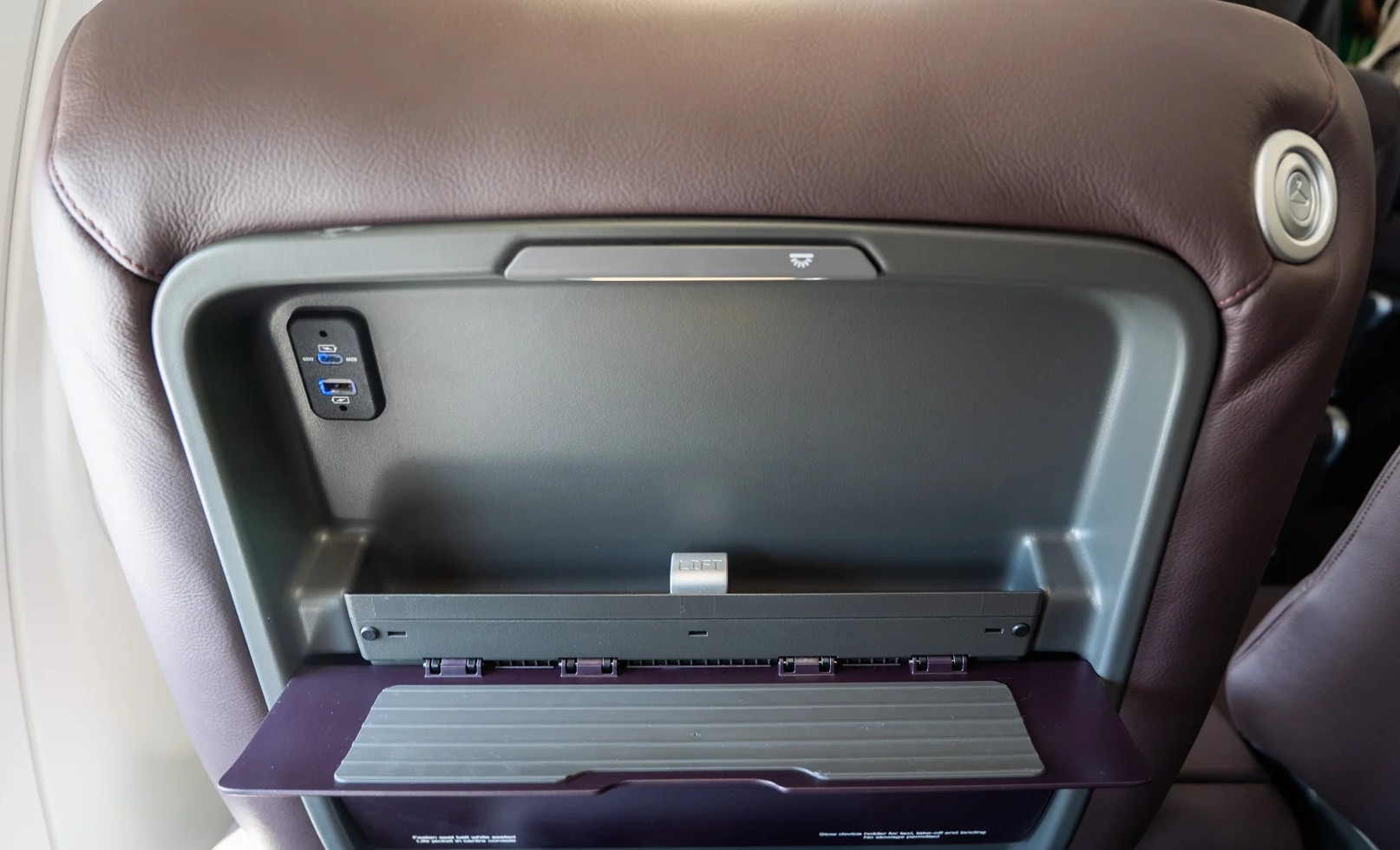
The detail that deserves the most credit is the storage compartment beside the seat, which doubles as a wireless charging dock for a phone and carries a subtle sensor light inside so you can find what you have put in there on a dark early morning or an evening sector. This is without a doubt one of the most undersold but overly utilised part of the design in this new cabin. Every seat also has both USB-A and USB-C charging, a winged headrest, and a device holder that becomes important for reasons covered further down.
Meal and Service
The pattern runs the way it should on a sector of this length, starting with a water offered before departure and moving into a full drinks service once the aircraft has levelled off. The meal arrived as a single substantial service rather than a series of small ones, and the chicken curry I chose came with bread alongside a salmon and potato salad, crackers and cheese, with an ice cream offered later in the flight.
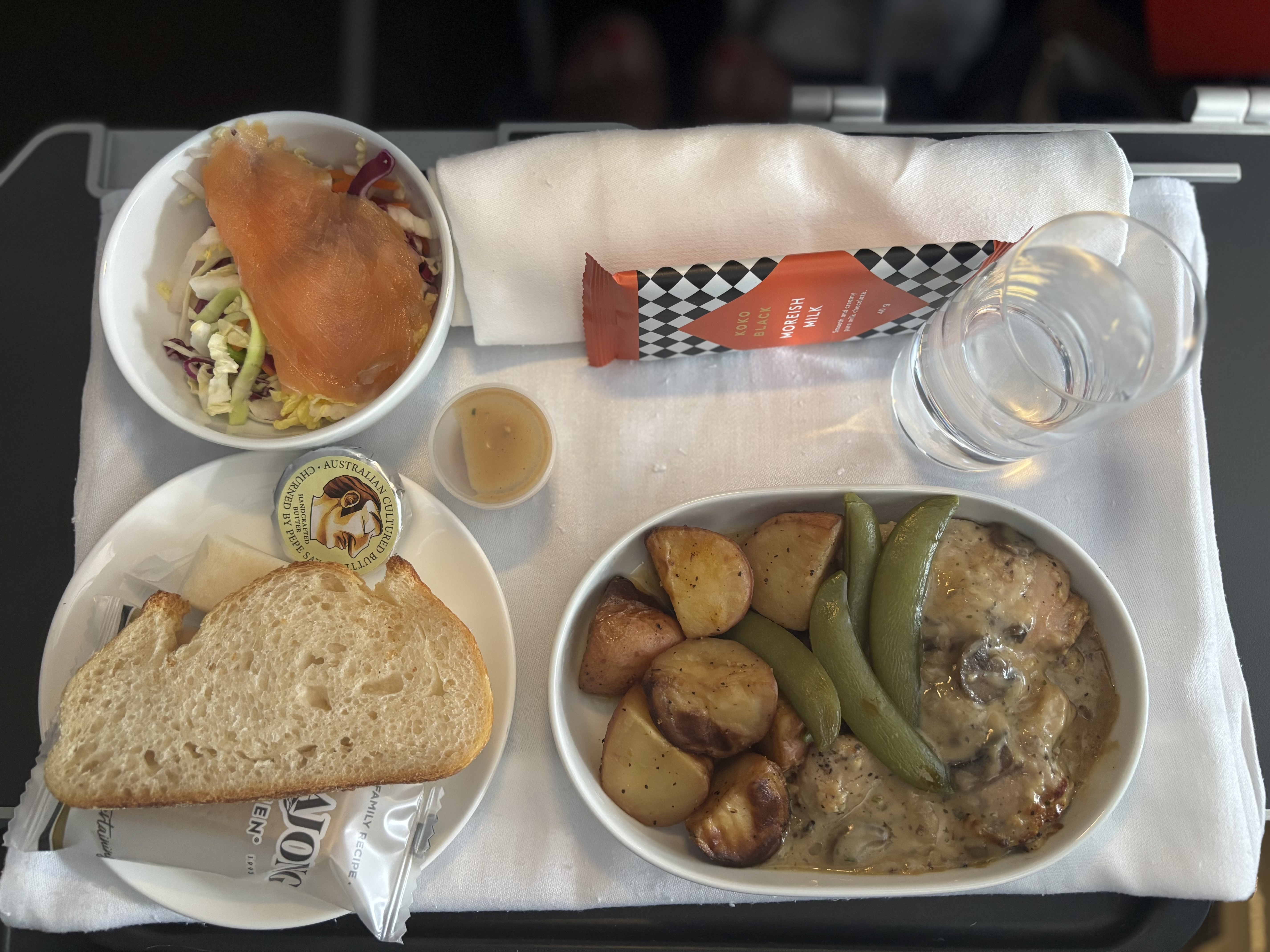
The food was good, very good in fact, but what held my attention was everything happening around it. Two gentlemen seated in front of me became fast friends just after take off and set about working their way through the onboard bar with considerable commitment. They held their drink well and caused no trouble at all, but they gave the crew plenty to do, and the crew stayed unfailingly kind and courteous throughout, happy to stop for a chat and quick to offer snacks alongside the drinks. The lady next to me wanted the opposite, having just finished eight days of bike riding, and the crew read that just as accurately and left her to sleep.
That contrast is the part worth sharing. Cabin crew can work through a service sequence competently while reading nothing about the people they are serving, but this crew did the better thing by adjusting their approach passenger by passenger with real personality behind it.
Entertainment and connectivity
There are no seatback screens on these aircraft, so entertainment streams to your own device through the Qantas app. Row 1 does not have a device holder so if you plan on relaxing with a film through the flight, rows 2 -5 are probably a better choice. The 737 fleet sits in much the same position now, with only around half the aircraft still carrying seatback screens. Passengers who prefer a screen should know that Qantas has committed to fixing this on part of the fleet, because 16 A321XLRs arriving from 2028 will carry lie-flat Business seats and seatback entertainment throughout the aircraft. Those airframes are aimed at longer transcontinental and international flying.
Complimentary Wi-Fi extends to every passenger on board but the speed is a limitation. The connection handled email and WhatsApp without complaint, though anything heavier defeated it and uploading an Instagram reel or even a single image near impossible.
Is it worth the fare?
The comparison that used to matter was Business on the 737-800, and against that, the A321XLR wins on seat width, storage, charging and overhead space. The Airbus narrowbody is simply a nicer aircraft to sit in, with slightly more cabin width and windows set at head height where the 737-800 places them closer to your shoulder.
The new competitor actually sits a few rows behind. Qantas has fitted Economy Plus seats to the A321XLR, 737-800 and A220 that offer 34 inches of pitch, rising to 38 inches in the exit rows and 39 inches in the front row, with priority boarding and first access to the overhead bins included. That product narrows the gap the Business fare has to justify, and it means the case for Business now rests on the recliner itself, the width, privacy, amenities, drinks menu, catering and service rather than legroom alone.
With up to 39 inches of legroom, priority boarding and early access to the overhead bins, Economy Plus delivers much of what many passengers are actually paying a Business Class premium for. The A321XLR Business Class experience is undoubtedly the better product, and if you can afford it there is simply no comparison, but passengers sitting somewhere in the middle now have a value question to weigh that did not exist before.
Then there is Australia's other carrier. Comparing like for like dates and times against Virgin Australia, Qantas comes in around $400 higher, and on a transcontinental sector the A321XLR delivers enough to account for that gap. Virgin also runs a smaller Business Class cabin, and the removal of the divider screens has reduced the overall privacy on offer.
For years, Qantas domestic Business Class was the obvious choice when comfort mattered, particularly on longer sectors such as Brisbane to Perth. The A321XLR raises the bar again, with a wider, more spacious cabin and a significantly better seat than the 737-800, while the arrival of Economy Plus changes the equation for anyone weighing up the fare. Either way, if you're travelling four to seven hours and are flexible with departure times, look for the A321XLR, because it is a winner at every point.
——————————————————————————————————————————————
This author flew as a guest of Qantas. However, as with all AirlineRatings reviews, the views, opinions and conclusions expressed in this article are entirely independent and are the author's own.
Have questions or want to share your thoughts?