Why a deliberate crash and four years of secrecy cost China Eastern their safety rating

By Sharon Petersen Tue Oct 13, 2026
China Eastern Airlines has held a five-star safety rating with AirlineRatings.com since flight MU5735 dived into a hillside in southern China in March 2022, killing all 132 people on board in a crash that was caused by deliberate action in the cockpit.
As with any fatal accident, we deduct stars at the time of a crash and then review the rating as more information comes to light. It became clear fairly early on that someone in the cockpit had most likely brought the Boeing 737-800 down on purpose, and our long-standing position is that an act like this should not cost an airline stars, because we treat it in much the same way as a terrorist attack or sabotage. In the case of China Eastern, the rating has stayed at five stars because of what happened next.
What happened to MU5735
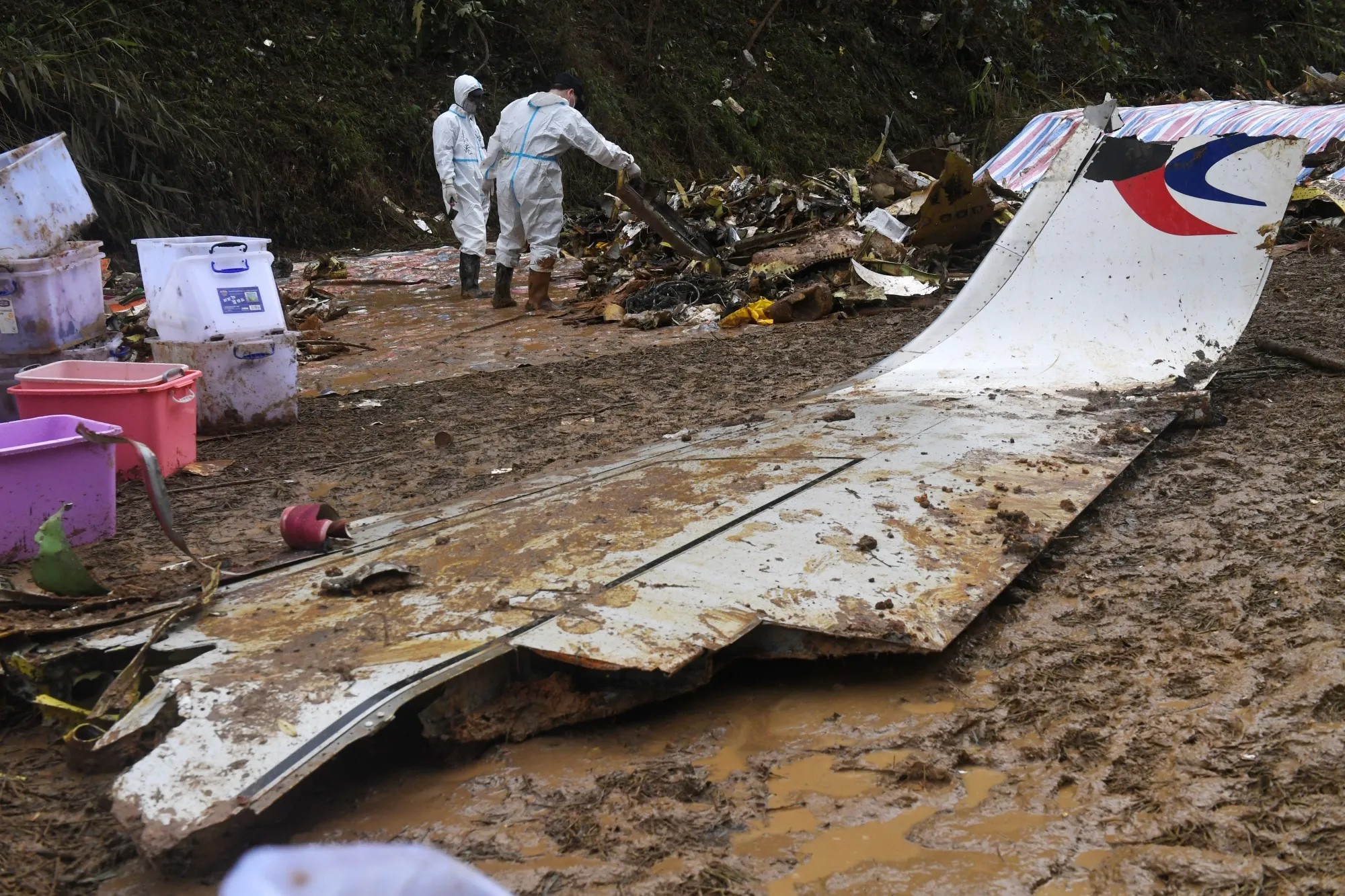
On 21 March 2022 China Eastern flight MU5735 was cruising at 29,000 feet on a scheduled service from Kunming to Guangzhou when it entered a near-vertical dive and struck a mountainside in Teng County, Guangxi, killing all 123 passengers and nine crew. It remains the deadliest air accident in mainland China in decades.
There was no distress call and no weather or traffic that could explain the descent, so attention quickly turned to the cockpit. Within two months, US media reported that American officials believed the aircraft had been put into the dive deliberately, a view the Civil Aviation Administration of China (CAAC) has never confirmed or denied.
The CAAC published a short preliminary report in April 2022 and brief anniversary statements in 2023 and 2024, the last of which said the engines showed no abnormalities before take-off. No final report has appeared, and Chinese officials have cited national security when asked why the cockpit voice recorder transcript remains unpublished.
The first hard evidence eventually surfaced in the United States. From 30 April 2026 and over the following weekend, documents began circulating online that claimed to come from a Freedom of Information Act (FOIA) request lodged from China with the US National Transportation Safety Board (NTSB), which assisted the investigation because Boeing built the aircraft. On 5 May 2026 the NTSB confirmed to The Aviation Herald that it had released the documents, explaining that its protocols allow it to release material from an investigation led by another country once that investigation is complete or two years have passed, whichever comes first. As the NTSB spokesman put it, "It has now been more than four years since the crash."
The NTSB's FOIA release can currently only be opened from US-based IP addresses, but The Aviation Herald has uploaded the NTSB's letter to the requester and its combined cockpit voice and flight data recorder download report so readers outside the US can access them.
That report shows one of the flight data recorder's memory chips was damaged beyond recovery, which leaves gaps in the data. Even so, the recording shows the fuel cut-off signals for both engines changing from RUN to CUTOFF while the aircraft was cruising at 8,900 metres (about 29,200 feet), followed about three seconds later by a forward push on one of the control columns and large aileron inputs that rolled the 737 through 180 degrees of bank. Former NTSB investigator Jeff Guzzetti says the dive that followed reached angles of up to 40 degrees.
The flight data ceases at about 7,900 metres (roughly 26,000 feet), around 21 seconds after both fuel switches are recorded at CUTOFF, because the engines were no longer generating electrical power. Guzzetti told US media that other parts of the data point to a struggle between the two pilots for the controls.
The cockpit voice recorder has its own backup battery and kept running, but the NTSB says it passed the audio only to Chinese authorities and kept no copies. That recording is the one piece of evidence that could show who moved the switches and why, and it remains in Beijing.
Why we don't normally deduct for pilot suicide
Our ratings measure how well an airline's systems keep passengers safe, covering training, maintenance, oversight, audit results and how the operator responds when something goes wrong. A pilot who sets out to destroy an aircraft is acting outside every one of those systems, and the industry's own history shows how hard that threat is to stop with procedures alone. No airline can be certain that every pilot has been vetted perfectly, and in reality someone determined to commit a crime like this will probably find a way, so we do not believe a whole airline should be penalised for the actions of one individual. That is our general rule, although there can always be exceptions, and China Eastern is one of them.
Germanwings flight 9525 in 2015, LAM Mozambique flight 470 in 2013 and EgyptAir flight 990 in 1999 were all deliberately crashed by a crew member, and the 2014 disappearance of Malaysia Airlines flight MH370 is widely suspected to be another case, although investigators never confirmed it. Each happened at an airline that otherwise met international standards. The industry's response has been better mental health support, peer programmes and cockpit procedures, and we would expect any well-run airline to have these in place.
Penalising an airline for the criminal act of one person would also blur what our ratings are meant to tell travellers, which is how likely an airline's systems are to protect them on an ordinary flight.
READ: Deliberate pilot actions such as on flydubai flight responsible for 20-30% of major disasters
So how did this cost China Eastern two stars?
What cost China Eastern its stars was the handling of the investigation that followed the crash, because openness after an accident is one of the clearest signs of a healthy safety culture. When the facts are shared quickly, every airline flying the same aircraft and every regulator overseeing similar crews can learn from them.
Under the international rules that govern accident investigations, the lead state should publish a final report within 12 months or release an interim statement on each anniversary. China has managed only brief statements, has issued nothing new since March 2024 and has given no timeline for a final report, more than four years after 132 people died.
Throughout that time the evidence pointing to a deliberate act sat with the investigating authorities while the public, the families and the wider industry were left without answers. China Eastern also grounded its 737-800 fleet in the days after the crash, which fed early speculation about a technical fault that the flight data now rules out.
An airline at the top of our scale needs to show it will be transparent when things go wrong, and that includes pressing its own regulator to publish the facts. Until a full and credible final report on MU5735 is released, we believe five stars is the right rating for China Eastern.
What would change the rating
We will review China Eastern’s rating once the CAAC publishes a final report on MU5735 that sets out the cause, the evidence from both recorders and the safety recommendations that follow.
So do we think China Eastern is safe? Yes we do, and our team flies the airline between the UK and China. To be a seven-star airline, though, a carrier must meet every one of our most stringent requirements. Keeping the facts of a fatal accident hidden for more than four years falls well short of the standard we expect at that level, because no accident, incident or deliberate act should ever be silenced.
Have questions or want to share your thoughts?