New analysis possibly identifies new MH370 location
By Geoffrey Thomas Mon Aug 20, 2018
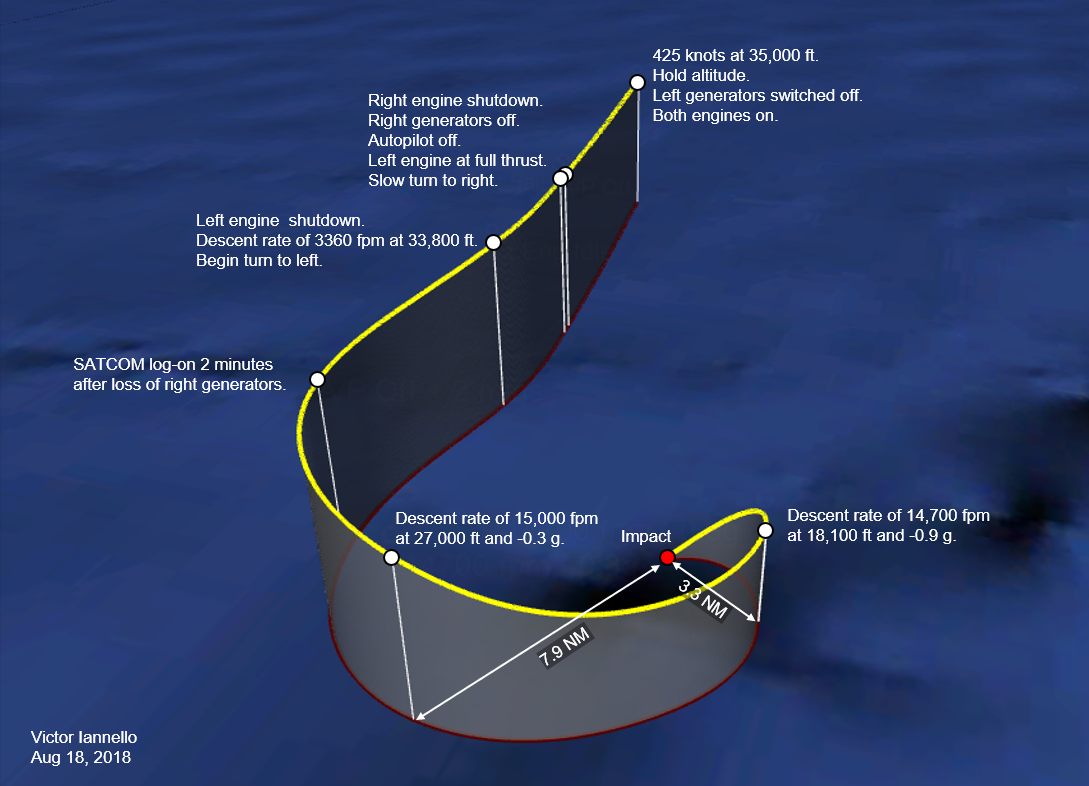
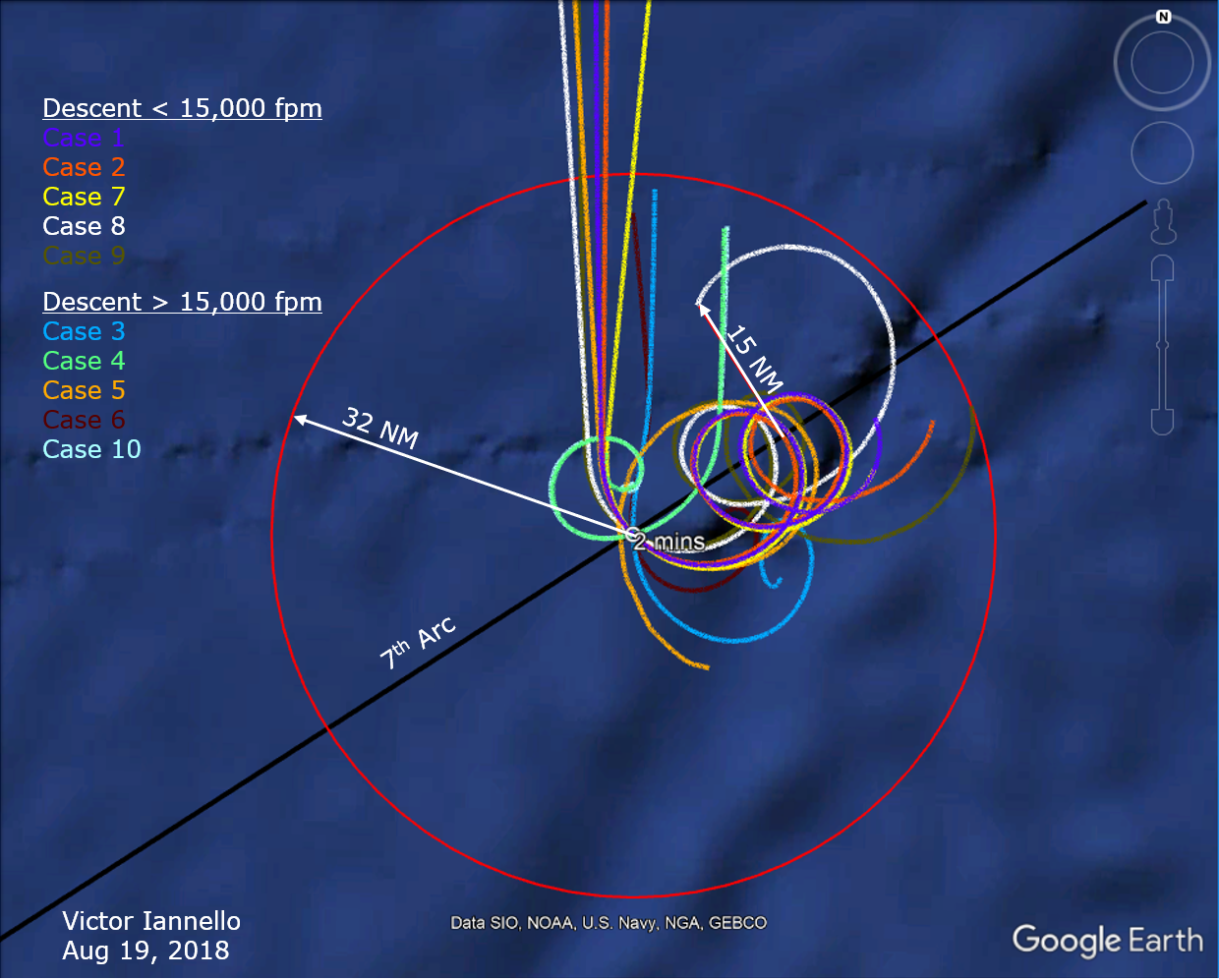
The possible final flight paths of MH370 have been examined by Independent Group member Victor Iannello after he was given exclusive access to simulation data produced by Boeing for the Australian Transport Safety Bureau.
After analyzing all the simulation data Mr. Iannello recommends “the next search should occur along the 7th arc north of 25S latitude at a width (from the 7th arc) of about +/-25 NM. (46km). The search up till now has been 22 NM either side of the 7th arc.
The 7th arc is the line that runs down and away from the Western Australian coast and is based on the Inmarsat satellite returns from MH370.
Recently one of the world’s most respected oceanographers the University of Western Australia’s Professor Charitha Pattiaratchi emphatically said that MH370 is lying just outside the area that has been searched.
“Yes absolutely, just outside where we have been looking,” Prof. Pattiaratchi said.
However, Prof Pattiaratchi says that the University drift modeling indicates that the priority region to target would be the area between 33°S and 28°S along the 7th arc.”
And CSRIO scientist David Griffin agrees with Prof Pattiaratchi. Read more here.
Mr Iannelloin his blog said that “with the failure of the recent search by Ocean Infinity to locate the debris field along the 7th arc at latitudes as far north as 25S and at widths equal to or exceeding +/- 22 NM, (41km)” we have to consider whether it is possible that with the assumption of uncontrolled flight, the plane could have impacted the ocean farther out.
Mr. Iannello asked the ATSB for more details about the conditions modeled and the results of the ten simulations that we used as the basis for the search.
“Although legal restrictions prevent the ATSB from providing specific details about each of the ten simulations (referred to as Cases 1-10), the ATSB did reveal that the initial speeds varied between M0.75 (894km/hr) and M0.83, the starting altitudes were either FL350 (35,000ft) or FL400, the initial headings were either 178°, 184° or 190°, and turbulence was either light or moderate. Winds at various altitudes were included in the simulations.”
The ATSB also provided Mr. Iannello with a variety of other data and has permitted him to share the results so that a broader group of investigators can independently analyze the results.
“To my knowledge, this is the first time these results have been released to the public,” said Mr. Iannello.
“Although not included in the files, derived quantities such as ground speed, Mach number, track, vertical speed, vertical acceleration, bank angle, and wing loading are all calculable, although some parameters such as Mach number and calibrated airspeed need assumptions about the wind and temperature fields.”
The 10 simulation case studies down by Boeing for the ATSB
Mr. Iannello found that “in none of the simulations did the plane fly straight with level wings after the autopilot was disengaged. Ultimately, the magnitude and direction of the bank that develops is the net effect of many factors, including thrust asymmetry, TAC, manual rudder input, weight imbalance, aerodynamic asymmetry, and turbulence, with the dihedral effect of the wings and center-of-mass tending to restore the bank to zero.”