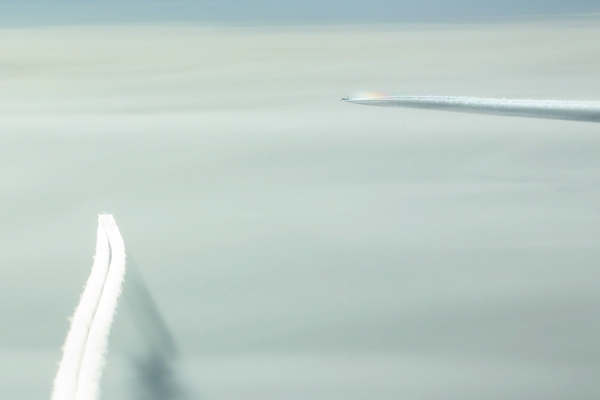
Two 747 planes in near miss

By Mon Oct 21, 2013
Warning systems on two 747 planes over Scotland have averted what would have been aviation’s worst collision disaster.
It could have killed almost 800 passengers and crew after pilots accepted the other plane’s air traffic control instructions to turn away.
A report from the UK Airprox Board reveals that in June the 747s came within 100m vertically and 4km laterally on a converging course and were just 30 seconds from each other.
The planes, a 344-seat 747-400 and a new 386-seat 747-8, were about to enter air lanes to cross the Atlantic Ocean when air traffic controllers realised they were headed for each other at the same altitude — 34,000ft.
The report said an air traffic controller issued timely warnings to the pilots but it was apparent both crews took the other’s instructions and the board found it hard to determine why.
“The board was surprised that all four pilots misheard or misinterpreted the avoiding action instructions despite at least one of the crews reading them back correctly,” it said.
The traffic collision avoidance systems on both 747s activated and issued opposite climb and descend instructions to the crews, which were followed.
One pilot assessed the severity of collision risk as “high”.
Last year, the board investigated 161 near misses in British airspace, of which 28 per cent were assessed as risk bearing.
There were 14 assessed as a collision risk and a further 36 deemed as “safety not assured”.
The worst midair collision occurred on November 12, 1996 in India when a Saudi 747 with 312 aboard and an Air Kazakhstan Ilyushin 76 with 37 passengers and crew collided.
The IL-76 dropped below its assigned altitude before landing and hit the 747. Neither had the TCA system which became mandatory worldwide after the incident.
But that did not stop midair disasters. In 2002, a Bashkirian Airlines Tupolev 154 hit a DHL 757 over Germany, killing 69.
Both received Traffic Collision Avoidance System (TCAS) instructions once the risk was detected but the Bashkirian pilot ignored the climb alert and followed last-minute air traffic control directions to descend.
It then became mandatory to follow TCAS alerts.
To see how a TCAS works see here.
Have questions or want to share your thoughts?