The Golden Age of Propellers. Was it Really That Golden?

By Mike Machat Sun Oct 18, 2015
Much has been written about flying aboard piston-powered airliners during the ‘Golden Age of Air Travel,’ best defined as the years following World War II through the introduction of jet airliners in the late 1950s. Superstar aircraft of this era include the Douglas DC-6 and DC-7, Boeing Stratocruiser, and perhaps the most iconic propliner of all time, the classic Lockheed Constellation.
In the accompanying advertisement, we see a husband-and-wife enjoying their sumptuous flight experience aboard a TWA Super Constellation as high-altitude sunlight beams through the curtained and rivet-ensconced window. The ad copy states, “You’ll really enjoy that high and mighty feeling when your course is charted along TWA’s fair-weather level.”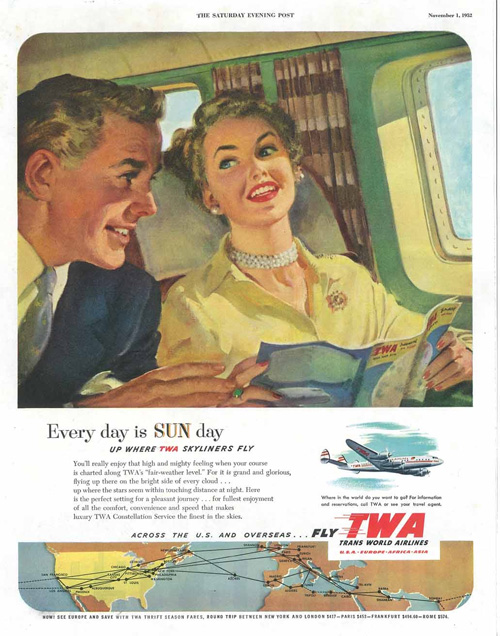
Flying above the weather was a bit of a novelty when the Super Connie first entered service in 1952. Capable of cruising at 25,000 feet in fully pressurized comfort, this new mode of air travel meant no more painful ear blocks, sinus attacks, or even airsickness from flying in the constant turbulence of weather at lower altitudes. Yes, “sick sacks” were once a staple of the propliner era, long before they became treasured collectibles at airliner shows today.
Reading further, “Here is the setting for a pleasant journey…for fullest enjoyment of all the comfort, convenience, and speed that make luxury TWA Constellation service the finest in the skies.” Comfort and convenience, sure - but speed? The 1049 Constellation cruised at 320 miles-per-hour giving it an average U. S. coast-to-coast flight time of approximately 12 hours. Compare that to any modern twin-engine turboprop commuter flying today.
The workhorse Embraer EMB-120 Brasilia flies the same speed as the Connie, while the SAAB 340s flies slightly faster at 325 mph. Other turboprops like the ATR-42 and -72, BAe Jetstream, and even the diminutive Fairchild Metro are all members of the 300-mph club. What made a 300-mph airliner such a stand-out in the 1950s, however, was that travel by more plebian modes of bus or train took three-to-four times as long to cover the same relative distance. Score one for air travel!
Oh, just one more thing, as a certain TV detective used to say. The term “high and mighty” was also the title of Ernie Gann’s award-winning novel and subsequent movie starring John Wayne and a young Robert Stack. (Yes, the same Robert Stack in the spoof “Airplane.”) Gann’s “High and Mighty” was the first of the famed ‘disaster movies’ with a harrowing tale of tense drama as a four-engine propliner experiences an inflight emergency. That’s probably not what these ad copywriters had in mind.
Have questions or want to share your thoughts?