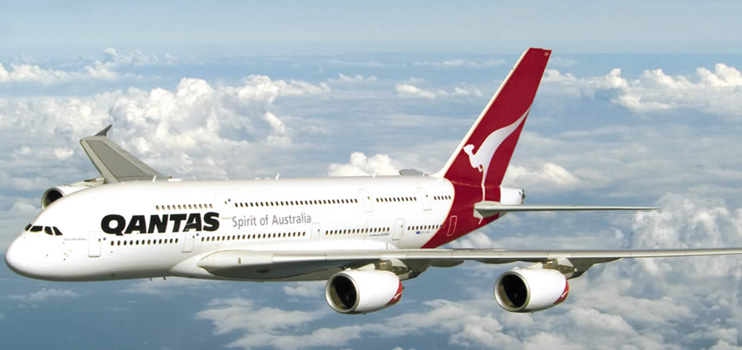
Qantas wake turbulence incident does not warrant safety investigation

By Steve Creedy Thu Jun 14, 2018
The Australian Transport Safety Bureau will not investigate an encounter with wake turbulence by a Qantas A380 after it determined the safety of the aircraft was not threatened.
The encounter generated a flurry of excited media reports after an alarmed passenger claimed QF94 went into a 10-second “freefall nosedive” while traveling from Los Angeles to Melbourne on Sunday. One outlet incorrectly described the incident as “a near disaster”.
But Qantas chief pilot Cpt Richard Tobiano told AirlineRatings.com in a statement: "It may have felt bumpy for the passengers, but the data shows the total up and down aircraft nose movement was three degrees. The reports of a nosedive or a plunge are wrong.”
The plane was about 20 nautical miles behind, and 1000ft below, another Qantas superjumbo headed to Sydney when it experienced what the airline described as a “short burst of wake turbulence”.
WATCH: Slipping into LAX at sunrise.
The ATSB said it was important to note that turbulence could be a distressing event for some passengers but "this may not reflect the operational situation".
“Media reports this morning that the ATSB is investigating a wake turbulence event involving an A380 are incorrect,’’ the bureau said in a statement. “Additionally, reports that the operator ‘failed to report the incident’ to the ATSB are also incorrect.
“Only occurrences that affect the safety of an aircraft must be reported to the ATSB. Based on the facts of this occurrence, there was no requirement for the operator to notify the ATSB immediately.
“The operator submitted a notification this morning, which is within the required 72 hour time frame for routinely reportable matters.
“The information contained in the notification has been reviewed and the ATSB has determined that it will not be investigating.”
Wake turbulence is caused by vortices — horizontal twisters —generated by an aircraft’s wings and the A380’s size means it can generate stronger wake turbulence than other aircraft. This can be particularly problematic for smaller aircraft.
There have been some serious incidents involving wake turbulence, including one in 2017 in which 15 people were injured on Qantas Boeing 747 approaching Hong Kong and another the same year where a German-registered business jet rolled several times after encountering wake turbulence from an Emirates A380.
READ Qantas 747 struck by wake turbulence.
In this case, Qantas would have been required to report the event immediately had there been serious injuries, structural damage or if the pilots reported difficulty controlling the aircraft.
The airline issued a statement saying it understood that any turbulence could be a jolt for passengers but aircraft were designed to handle it safely.
“As the Captain explained to passengers at the time, this A380 experienced a short burst of wake turbulence from another A380 flying ahead and above it,’’ she said.
“There are a lot of safeguards in place to reduce the likelihood of wake turbulence encounters, but it’s hard to eliminate.
“Unexpected turbulence is why we always recommend passengers keep their seat belt firmly fastened at all times just as pilots do in the flight deck.”
Australian television and radio personality Eddie McGuire was on the plane and agreed the turbulence got his attention.
"Somebody described it as the feeling of going over the top of a rollercoaster, you know slightly, not the full down, just a little - 'uh, what's going on there?'," he told radio station Triple M. "There was a little bit of turning of the plane as well and a little bit of downward."
McGuire said it was a case of "'hello' it's got your attention, what's going on?".
"Then it leveled off,'' he said.
“I thought the Qantas staff were fantastic. The captain of the aircraft got on and told everyone immediately, 'this is what happened, relax. That was something a bit different, we've run into these things at the moment, we're now talking to air traffic control and we're going to get a different flight path - we should be right from here,'."
Have questions or want to share your thoughts?