Flying to Nepal? You need to read this

By Sharon Petersen Tue May 19, 2026
Recommending a truly safe airline to fly in Nepal is hard. The country's terrain, weather and infrastructure combine to create one of the most demanding operating environments in commercial aviation. No airline registered in Nepal can currently achieve AirlineRatings perfect seven (or seven-star PLUS) safety rating, in-fact historically, no airline could score higher than a three out of seven for safety…until now.
Why do airlines in Nepal have such low safety ratings
There are three main reasons that result in consistently low safety ratings for Nepalese carriers on airlineratings.com.
Firstly, the EU airspace ban. The European Union banned all Nepali carriers from EU airspace on December 5th 2013. Whilst most Nepali airlines have no commercial need to operate in to Europe, the ban reflects assessment of the regulatory and operating environment in Nepal and this results in the loss of one star for safety in the seven star rating system.
Secondly, the operating environment. Short runways, unpredictable mountain weather and challenging high-altitude terrain define the airspace making Nepal one of the world's hardest places to fly. Some operators also use older aircraft that are specialised for this terrain but that have less advanced safety systems.
Accident records reflect these conditions with Aviation Safety Network recording at least 20 accidents in Nepali airspace since 2006, with more than 222 fatalities. Events include:
Yeti Airlines Flight 691, January 2023, all 72 killed on approach to Pokhara after an accidental engine feathering
Saurya Airlines, July 2024, 18 killed when a CRJ200 rolled and crashed on takeoff from Kathmandu
Tara Air Flight 197, May 2022, all 22 killed in controlled flight into terrain near Jomsom
Tara Air Flight 193, February 2016, all 23 killed in the Myagdi mountains
Nepal Airlines, February 2014, all 18 killed in Arghakhanchi
The third reason Nepalese airlines struggle to obtain higher safety scores is their absence on the IOSA (IATA Operational Safety Audit) registry. IOSA is a globally recognised safety audit programme that assesses an airline's operational management and control systems against international standards. IOSA carries weight because the data is unambiguous. The IATA 2025 Safety Report shows IOSA-registered airlines recorded an all-accident rate of 0.98 per million sectors, against 2.55 for non-IOSA carriers.
In simple terms, IOSA carriers run roughly two and a half times safer than non-IOSA carriers. The gap has held for two decades. This is so important to the AirlineRatings safety rating system that it alone is worth two of the seven safety stars available.
For years, not a single Nepalese carrier carried IOSA certification however this all changed on December 28th 2023 when Himalaya Airlines become the country's first and only IOSA Registered Operator.
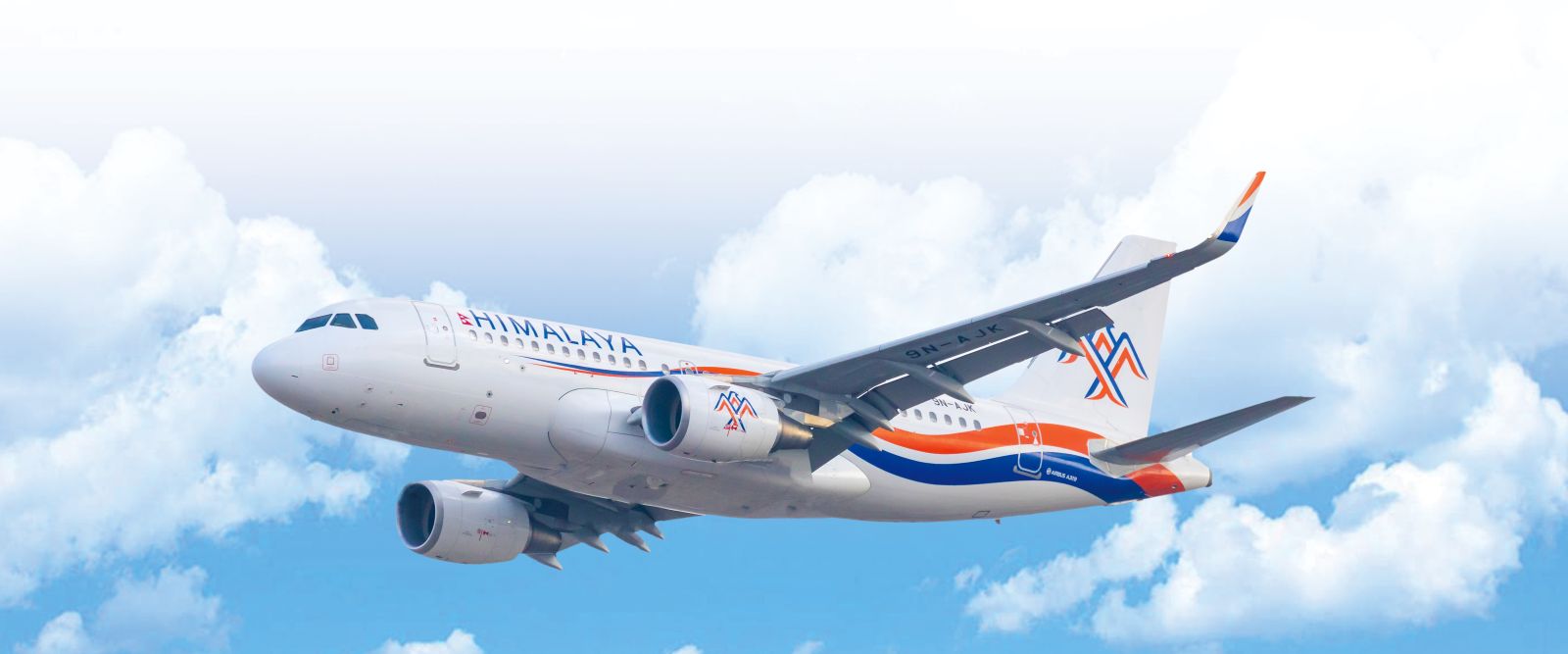
On the recognition, Deputy Director General of Aviation Safety & Security Regulation Directorate Nabina Karmacharya remarked," On behalf of Civil Aviation Authority of Nepal, I commend Himalaya Airlines for their exceptional dedication to safety leading to the prestigious IOSA certification. This accomplishment of Himalaya has definitely helped in reinforcing trust and confidence amongst the passengers, contributing significantly towards the growth and development of air travel in the country.”
With Himalaya Airlines holding IOSA certification along with a fatality free history, it scores a five out of seven for safety. That makes it the highest safety-rated airline based in Nepal.
More on Nepal’s airlines
Himalaya Airlines (H9) — international
The IOSA-registered carrier operates four Airbus A320 family aircraft. The average fleet age sits at 8.5 years making Himalaya the youngest jet fleet of any Nepali carrier.
Nepal Airlines (RA) — flag carrier, international and domestic
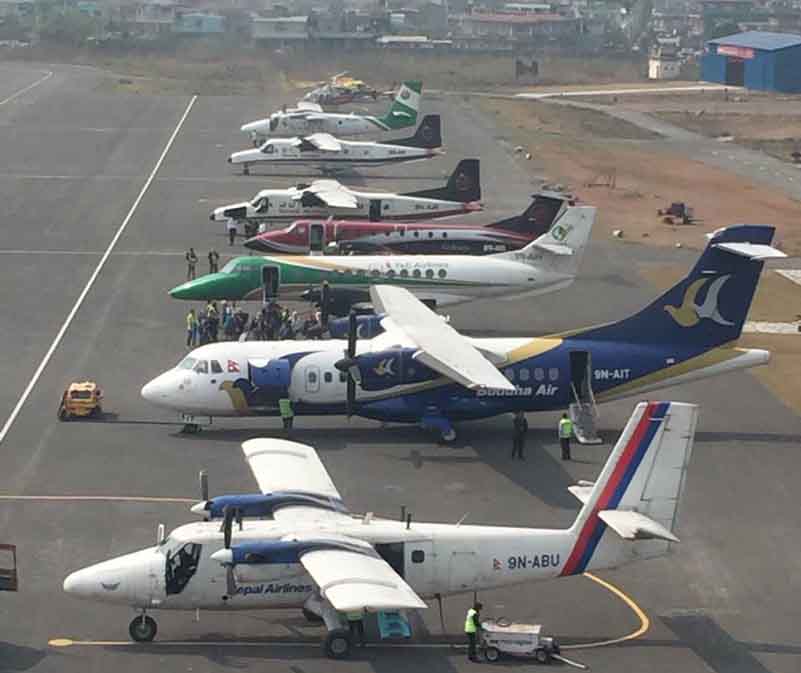
The state owned operator runs a six-aircraft fleet including two Airbus A330-200s, two Airbus A320s and two DHC-6 Twin Otters. The Airbus aircraft themselves average 9.5 years, but the Twin Otters are nearly 42 years old.
Buddha Air (U4) — largest domestic operator
The largest domestic carrier by fleet size operates around 16 ATR 42 and ATR 72-500 turboprops. Average fleet age sits close to 20 years.
Yeti Airlines (YT) — second-largest domestic
The carrier operates an all-ATR 72-500 fleet of seven aircraft with an average age of 17.5 years.
Tara Air (TB) — Yeti Airlines subsidiary, STOL mountain operations
The mountain carrier operates a three-aircraft fleet of DHC-6 Twin Otters. Two of these aircraft are 13 years old. The third is 45 years old.
Shree Airlines (NB) — third-largest domestic
The third-largest carrier operates a mixed fleet of nine aircraft including seven Dash 8-Q400 turboprops, one Bombardier CRJ-200 and one CRJ-700. The average age sits at 18.5 years.
Who should I fly within Nepal?
Whilst Himalaya Airlines holds the highest safety rating, it doesn't fly domestic or regional routes just international.
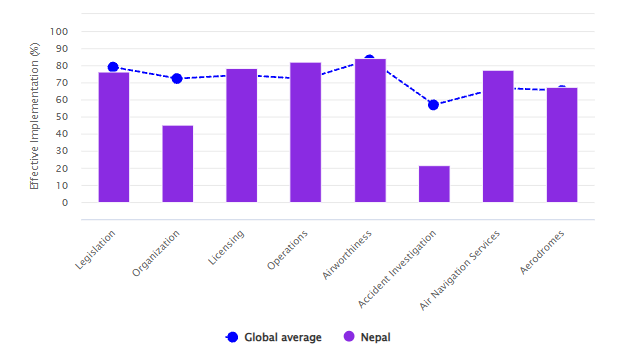
Given all the parameters including incident rates, prior accidents and fleet composition, it is impossible to recommend one airline over another for domestic service within Nepal. In good news though, the country of Nepal has made huge strides in air navigation, aerodrome and operational safety across the country. As the graph below shows, Nepal now meets global standards in six ICAO country audit parameters. These parameters don't reflect an airlines safety, but they do give an idea of the systems in place within the operating country of jurisdiction to maintain safety.
The bottom line
So where does that leave a traveller? Himalaya Airlines is the Nepalese Airline we would choose for any international service in or out of Nepal because it holds the country's highest safety rating and is the only Nepali carrier on the IOSA registry. For domestic flying, the picture is less clean. Every operator faces the same terrain, the same weather and in many cases ageing Twin Otters aircraft on the toughest sectors. That risk applies across the board, not to any one airline. Nepal's broader safety improvements at the country level are real and worth crediting, but they don't yet translate into a domestic carrier we can single out at this stage.
Have questions or want to share your thoughts?