Virgin Australia posts $A186m net loss

By Steve Creedy Wed Aug 9, 2017
Virgin Australia says subdued domestic trading and a move to simplify its fleet are largely responsible for an annual net loss of $A185.8 million ($US146.5m).
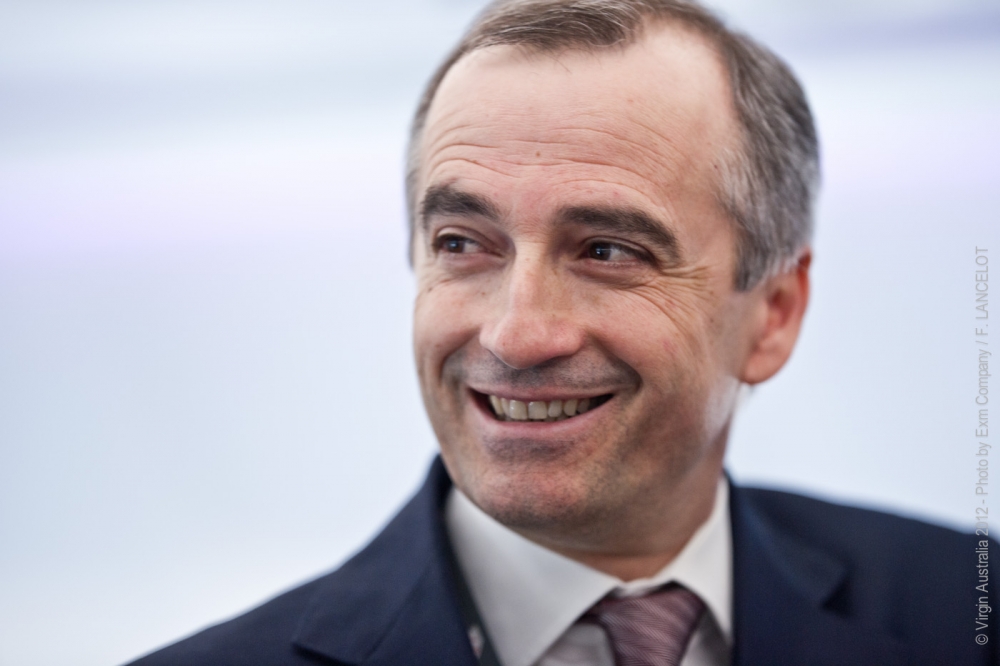
But chief executive John Borghetti expects positive momentum seen in the fourth quarter of 2016-17 to continue into the start of the current financial year.
He also pointed to balance sheet improvements that saw the airline free cash flow positive for the first time since fiscal 2012 and an $A839 million reduction in net debt.
The 2016-17 net profit was an improvement of $A38.9 million on the 2016 financial year and included restructuring charges from its Better Business program as well as an income tax benefit of $A103.8m.
This put the airline’s pre-tax loss at $A289.6 m, down from $426.6m the previous year, and saw it remain in the red on an underlying pre-tax basis with a loss of $A3.7 million
Group revenue rose $A26.3 million to $A5.05 billion.
The group’s underlying performance improved by $A38.4 million in the fourth quarter and Borghetti said improving yields were due to a number of factors.
“The first is that I think capacity is at more sustainable, rational levels across the industry so there’s a better match... between demand and capacity, he said.
Borghetti also pointed to reports that business confidence in Australia was running ahead of consumer confidence was consistent with what the airline had seen in the fourth quarter of last financial year.
He said business travel appeared to have picked up more than leisure travel and had translated to improved yields and that was expected to continue in the current quarter.
“And of course, importantly, the better business plan, which has helped us in our efficiencies and aircraft utilisation as we’ve simplified the fleet,’’ he said.
The restructuring charges incurred last financial year mostly relate to the fleet simplification and the airline still has to replace the Tigerair fleet of Airbus A320s with Boeing 737s.
But chief financial officer Geoff Smith said the Airbus planes were “much more marketable and tradeable in the international aviation market’’.
“So I would say the bulk of those restructuring charges have indeed been incurred,’’ he said.
Borghetti also noted the restructuring charges were an upfront cost that would deliver “significant long-term cash flow savings”.
Virgin is a year into a three-year structuring program that Borghetti said was ahead of schedule as he announced an increase in savings targeted by the program of $50m a year to $350m annually.
Commenting on the airline’s business segments, Borghetti said the airline’s domestic performance was affected by subdued trading conditions and reduced demand for regional and corporate travel.
Although the trading conditions had been subdued, he said this did not mean the airline had lost share to bigger rival Qantas.
“We managed capacity prudently in response to these conditions, with sectors flown declining 5.9 per cent on the prior financial year,’’ he said, adding that domestic had also seen a fourth quarter improvement.
Underlying earnings before interest and tax at the domestic operations came in at $A92.9m with International recording underlying EBIT of $0.5m, $A49.3m head of the previous year.
Borghetti said that although trading conditions had been subdued, this did not mean the airline had lost domestic market share to its bigger rival.
“Virgin Australia International was profitable for the 2017 financial year, a result supported by growth in yield and unit revenue,’’ Borghetti said. “These positive outcomes have been driven by the international improvement strategy that the group commenced two years ago.’’
Tigerair Australia recorded an underlying EBIT loss 24.3m, a decline on the previous year of $A26.5m
“Tigerair Australia’s domestic operations were also profitable, with the business delivering passenger and unit growth revenue,’’ Borghetti said. “Tigerair’s overall underlying performance, including international operations, was impacted by the launch and withdrawal of operations from Denpasar (Bali).’’
The airline’s Velocity program continued its growth trajectory to exceed its 2017 membership target and reach more than 8 million members and reported revenue of $A371m.
“Velocity also improved its underlying profitability this year and forged a number of important new partnerships, including deals with Flybuys, Energy Australia and Bupa,’’ the Virgin chief said.
Have questions or want to share your thoughts?