TWA's First Boeing 707

By Mike Machat Tue May 31, 2016
We’ve seen Boeing’s incomparable 707-300 “Intercontinental,” the first jet airliner to connect all seven continents. TWA was the second U.S. airline to fly the 707-300, but before these great airliners entered service, that airline inaugurated Boeing 707 service in the U.S. with the very first iteration of the exciting new jet.
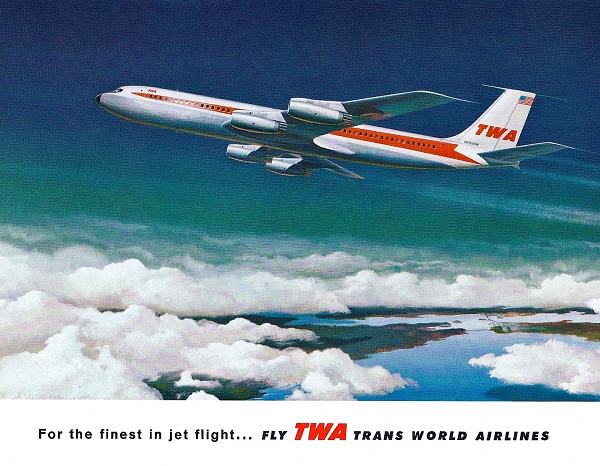
Seen here in this classic brochure cover painting by the renowned Ren Wicks, is TWA’s first 707 called the model 120, or actually the “131” in TWA usage. This aircraft had a shorter fuselage and smaller wing than the Intercontinental, and carried only 140 passengers in mixed-class service, versus 185 passengers in the 707-331 series.
The first 707s were powered by four Pratt & Whitney JT3C turbojets which produced all of 13,500 pounds of thrust each, a significant jump in overall power compared to earlier propliners, but a rather anemic amount of thrust by today’s standards. To boost that power, distilled water was injected into the engine’s combustion chambers on takeoff, which created a bit more thrust plus a lot more thick black exhaust smoke.
These engines gulped fuel at a ferocious rate, emitted pollutants into the atmosphere, and produced shrill ear-piercing noise, but it was a different world in 1959, and these seemingly negative factors were more readily accepted by the mass public. After all, now you could fly from New York to London or Paris in only six hours, and what was not to like about that?
TWA’s first 707 measured 145 feet long with a wingspan of 130 feet and weighed 250,000 pounds at takeoff. It used about 1,000 to 2,000 feet more runway for takeoff and landing than its DC-7 or Constellation predecessors, depending on payload weight and weather conditions.
Entering service on TWA’s flagship San Francisco - New York route on March 20, 1959, the new jet competed head-to-head with American Airlines’ transcontinental 707 flights which began in January that same year. Travel time was five-and-one-half hours eastbound, and one hour longer westbound - less than half the time of the prop planes.
In retrospect, this “first step” in U. S. commercial jet transportation seems almost insignificant today, but it was revolutionary at the time. Ren Wick’s dramatic illustration beautifully conveys the power, speed, and majesty of flying high in the stratospheric at nine-tenths the speed of sound, something that could only be dreamed of before 1959.
Have questions or want to share your thoughts?