From First Circuit to Full Flight Deck: How MOZA Built a Flight Sim Ecosystem That Grows With You

By Airline Ratings Tue Aug 18, 2026
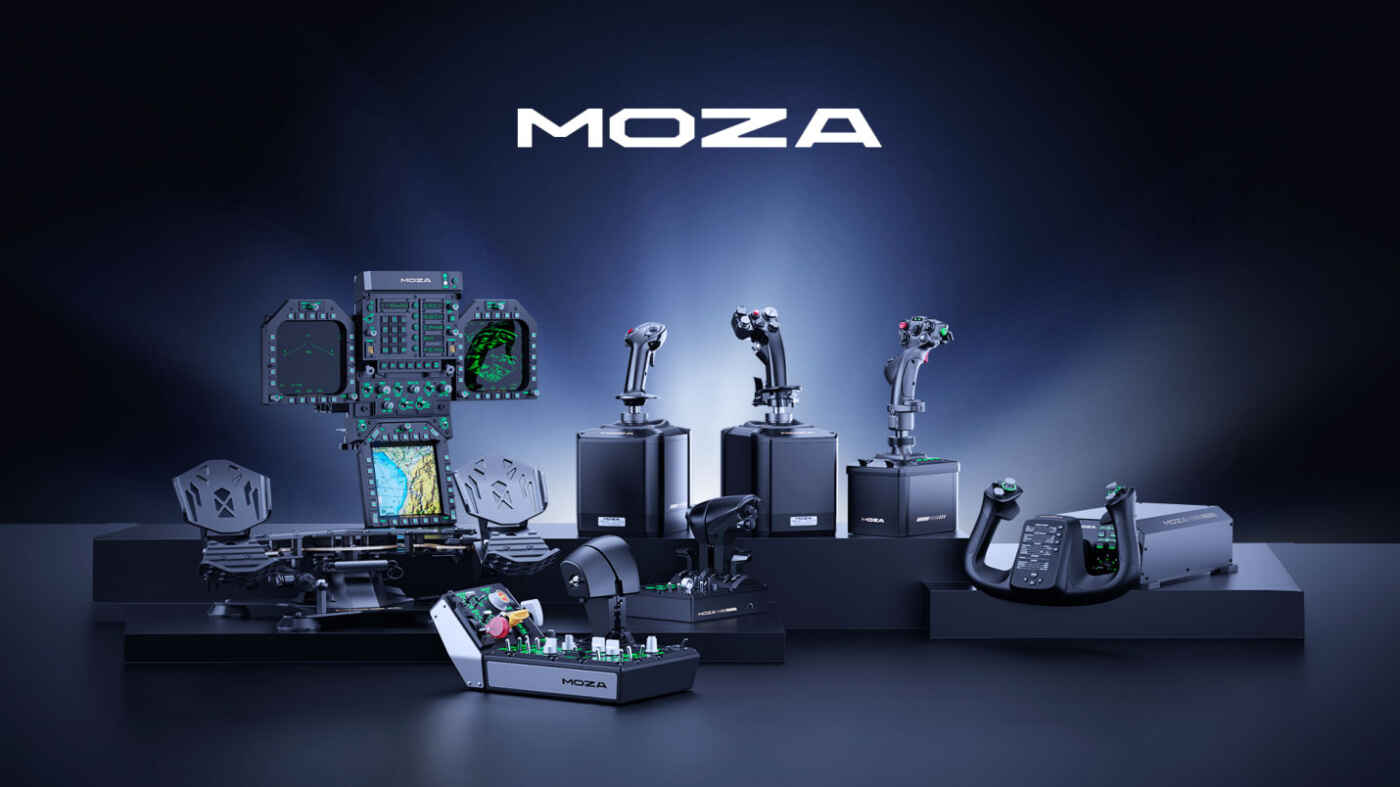
MOZA entered flight simulation in 2024. Two years later it sells everything from a $99 autopilot module to an advanced modular combat flight simulation setup, all running through one piece of software. Here is how the range fits together, whichever end of it you start at.
The problem MOZA set out to solve
Ask anyone who has tried to build a home cockpit what stopped them. The answer is rarely enthusiasm. It is usually the tangle of incompatible parts, the hunt for spare HDMI outputs, the third-party configuration tool that breaks after every simulator update.
MOZA has spent two years attacking that problem from the opposite direction. Rather than selling one flagship device, the company built a modular family where every piece talks to every other piece through a single application. You can enter the range for the price of a decent headset. You can also end up with an Airbus-style flight deck that would not look out of place in a training centre.
That range is the reason MOZA now deserves a serious look from two very different readers: the enthusiast flying their first circuits in Microsoft Flight Simulator, and the pilot who wants meaningful procedural practice between real sessions.
Starting out: get the feel right first
The single biggest upgrade for a new sim pilot is not scenery. It is a control that loads up properly when you pull on it.
The MOZA AB6 Flight Simulator bundle is the natural first purchase, pairing a force feedback base with a stick in one box. If you would rather build piece by piece, the MHG Flightstick uses a carbon fibre reinforced composite body with a Hall-effect hat switch and 29 programmable inputs, while the MA3X Side Stick gives Airbus flyers the correct hand position from day one at a genuinely modest price.
Add the Z-Axis Module when you want rudder authority through the stick, or the Adjustable Desktop Clamp if you are working from a desk rather than a rig.
None of this requires a permanent cockpit. That matters more than it sounds. Most people abandon home simulation because setting up takes longer than flying.
Force feedback that teaches you something
MOZA's July launch brought the AY90 Force Feedback Yoke Base to market at $399 USD, sitting below the existing AY210 Yoke Base and its 9 Nm peak torque.
The AY90 delivers 4.2 Nm of roll torque, 90 N of push-pull force and 95 mm of travel. The specification matters less than what it reproduces. Control loading changes with airspeed. Trim genuinely offloads the yoke. Stall buffet arrives through your hands rather than through a caption on screen. Turbulence and landing impact register physically.
For anyone learning aircraft handling, that feedback loop is the whole point. You stop flying the numbers and start flying the aeroplane. The AY90 supports Microsoft Flight Simulator, X-Plane and DCS, with profile import arriving in a future MOZA Cockpit update.
Pair it with the MFY Pro Yoke Handle at $299 USD and you get a 4.3-inch touchscreen built into the yoke itself, carrying aircraft information and customisable cockpit pages. For single-monitor setups this solves a real problem: you stop clicking through menus that obscure the view outside. The MFY Pro carries 26 programmable inputs, Hall-effect thumbsticks and MOZA's quick-release system, and it fits both the AY90 and the AY210. The standard MFY Yoke Handle remains the budget option.
Prefer a stick? The AB9 FFB Base and MH16 Flightstick cover combat and fast-jet flying, with the MTQ Throttle Quadrant, MTP Throttle and MTLP Panel filling out the left-hand console.
The airline flight deck, module by module
July 2026 marked MOZA's most significant expansion so far: a full family of avionics panels and cockpit displays.
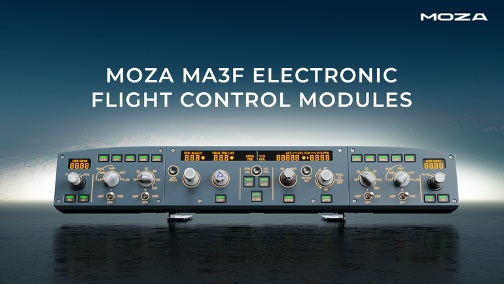
The MA3F Electronic Flight Control Module recreates the Airbus FCU and EFIS layout, including a dual-rail push-pull mechanism engineered to reproduce the tactile behaviour of the real autopilot selectors. Anyone who has watched a line pilot pull for selected, push for managed will understand why that detail justifies its own paragraph.
It starts at $149 USD for the core module, with left and right EFIS wings at $99 USD each. Buy the centre section now, add the wings later.
Flight management gets the same treatment. The MA3F Flight Computer Display covers the Airbus MCDU workflow and the MB7F Flight Computer Display covers the Boeing FMC, both at $199 USD. High-resolution IPS panels sit behind die-cast metal front plates with professional-grade switches, and both units synchronise with the simulator in real time.
The practical benefit is procedural rather than cosmetic. Using physical controls makes cockpit workflows more tactile and intuitive, reducing reliance on mouse input and helping create a more immersive simulation experience.
General aviation and the training case
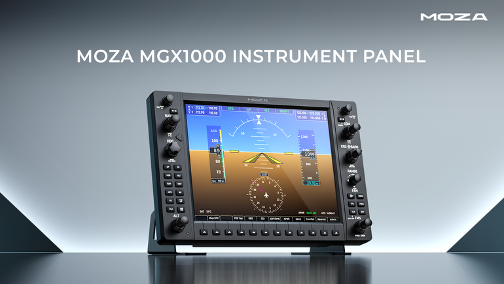
The MGX1000 Instrument Panel is the product most likely to interest readers with a logbook. At $449 USD it brings a true-to-size 10.4-inch IPS display in a G1000-style layout, with precision rotary encoders and integrated navigation functions.
MOZA positions it explicitly for general aviation enthusiasts, training applications and cockpit builders, and multiple units can be combined to recreate a full PFD and MFD pairing.
One honest caveat worth stating plainly: consumer hardware like this is not an approved training device, and time flown on it does not log towards a licence. What it does offer is unlimited, zero-cost repetition of the flows that eat expensive aircraft hours. Approach setup, flight plan amendment, failure drills, avionics familiarisation on a new type. Every instructor has watched a student burn twenty minutes of Hobbs time relearning a menu tree. That is exactly the work this hardware absorbs.
Military and tactical simulation
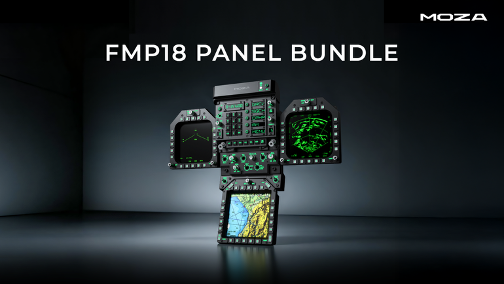
For the combat side, the FMP18 Panel Bundle at $849 USD builds a front cockpit inspired by one of the most recognisable carrier-based fighters in service. It combines multiple integrated displays, authentic control layouts and a magnetic swappable bezel structure with Pogo Pin connections, so builders can change frames quickly for aircraft-specific layouts. The AMPCD Display Panel extends the same idea further down the console.
The part nobody advertises but everybody needs
Two engineering decisions do more for the ownership experience than any single product.
The first is DisplayLink. MOZA's current display connects over USB rather than HDMI. No additional graphics outputs, no capture cards, no negotiating with your GPU over how many screens it will tolerate. For multi-panel cockpits this removes the most common technical barrier outright.
The second is MOZA Cockpit, the software layer that handles input mapping, control parameters, lighting and telemetry across every connected device. MOZA has also partnered with MobiFlight to widen panel compatibility further, which matters to anyone already running a mixed-brand cockpit.
MOZA develops its servo motors, control algorithms, structural engineering and software in-house. This vertically integrated approach helps MOZA create a more consistent hardware and software experience across its flight simulation ecosystem.
Where to start
Entry: around $550 USD. AB6 bundle plus Z-Axis Module. Force feedback, rudder authority, no rig required.
Serious GA: around $1,150 USD. AY90 Yoke Base, MFY Pro Handle and MGX1000 Instrument Panel. A glass cockpit you can actually practise procedures on.
Airline flight deck: around $1,300 USD and upward. MA3F EFCM with both wings, your choice of Airbus or Boeing flight computer display, AY210 base and MFY Pro handle.
Each tier is a real stopping point. The modular approach allows users to expand their setup over time while keeping existing compatible hardware as part of the ecosystem.
The verdict for our readers
MOZA has achieved something unusual in this market. It serves the newcomer who wants one box that works, and it serves the builder chasing a specific aircraft down to the switch. Most brands pick one of those customers.
For readers who fly for a living, the appeal is procedural repetition without aircraft cost. For readers who fly for love, it is the shortest route from a desk to a flight deck that responds like the real thing.
Browse the complete MOZA Flight Series or find an authorised retailer near you.
All prices are MOZA recommended retail in USD as at July 2026 and vary by region. AirlineRatings.com maintains full editorial independence over its safety and product ratings.
This article is sponsored content produced in partnership with MOZA. Explore the full MOZA Flight Series here.
Have questions or want to share your thoughts?