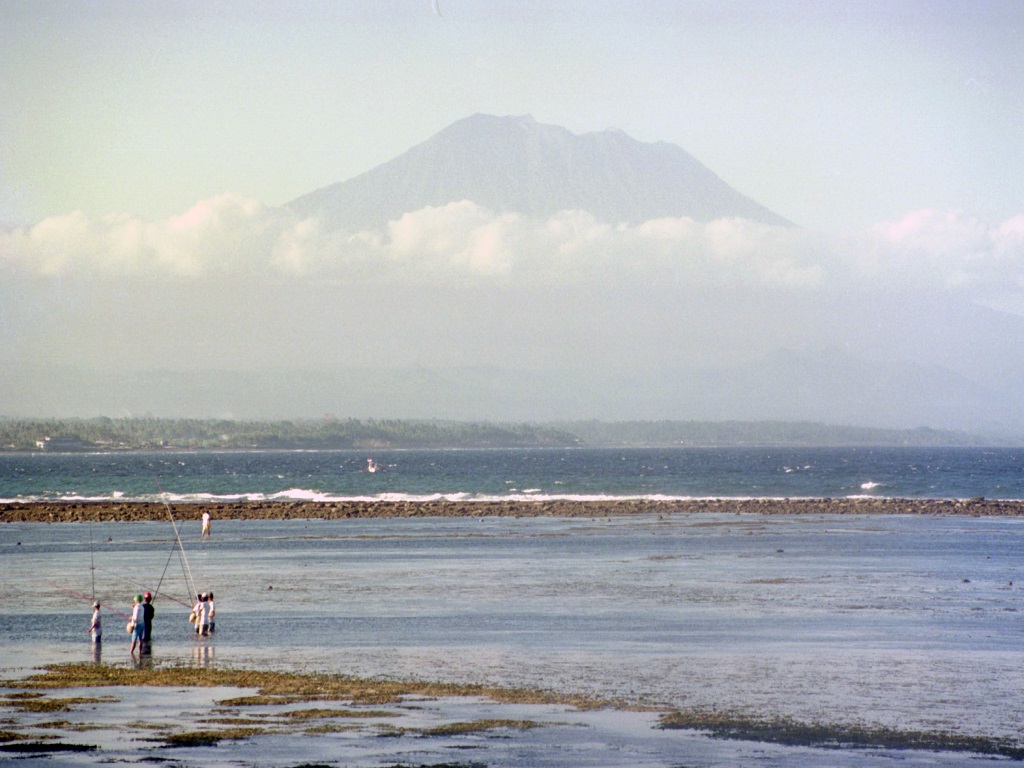
Bali's Mount Agung eruption imminent

By Geoffrey Thomas Mon Sep 25, 2017
Tremors from Bali’s Mount Agung are increasing in number and intensity and getting shallower, indicating an eruption is close.
Flights to the holiday island continue as normal from around the globe.
Read: Virgin Australia's volcanic hedge
Over 38,000 local residents have been evacuated to shelters and a 12km exclusive zone placed around the volcano, which is 70km from Kuta.
However, expert volcanologists have warned that if and when Mount Agung erupts, the event could be explosive and at the higher end of the scale.
 When Mount Agung erupted in 1963, almost 2000 died and the volcano stayed active for a year.
That eruption was of the explosive intensity as Mount St Helens in 1981 and Mount Pinatubo in 1991.
Yesterday, Professor Heather Handley, an ARC Future Fellow in the Department of Earth and Planetary Sciences at Macquarie University in Sydney, Australia, said “there has been a significant increase in recent days of volcanic earthquakes below the volcano.”
“The location of the earthquakes has changed over time, becoming shallower and suggesting that magma is moving closer to the surface and an eruption may be imminent”.
Professor Handley said “seismic crisis” was not always followed by a volcanic eruption but the number and depth of volcanic earthquakes in recent days at Agung had not been witnessed since the previous eruption and had caused the alert level to be raised to its highest level.
“If Mount Agung erupts and the eruption is similar to its two previous large-scale eruptions then we might expect to see Lava flows reach several kilometers from the summit, in any direction and deadly pyroclastic flows travel tens of kilometers from the summit,” she warned.
“Due to the high level of sulphur dioxide in magma erupted at Agung, if this mixes with water vapor in the atmosphere it can create sulphric acid and so acid rain could be an issue”.
These sulphur aerosols can last several years in the stratosphere, if the eruption column is more than 6 miles high (10km) , and block incoming solar radiation, leading to longer-term global temperature effects.
When Mount Agung erupted in 1963, almost 2000 died and the volcano stayed active for a year.
That eruption was of the explosive intensity as Mount St Helens in 1981 and Mount Pinatubo in 1991.
Yesterday, Professor Heather Handley, an ARC Future Fellow in the Department of Earth and Planetary Sciences at Macquarie University in Sydney, Australia, said “there has been a significant increase in recent days of volcanic earthquakes below the volcano.”
“The location of the earthquakes has changed over time, becoming shallower and suggesting that magma is moving closer to the surface and an eruption may be imminent”.
Professor Handley said “seismic crisis” was not always followed by a volcanic eruption but the number and depth of volcanic earthquakes in recent days at Agung had not been witnessed since the previous eruption and had caused the alert level to be raised to its highest level.
“If Mount Agung erupts and the eruption is similar to its two previous large-scale eruptions then we might expect to see Lava flows reach several kilometers from the summit, in any direction and deadly pyroclastic flows travel tens of kilometers from the summit,” she warned.
“Due to the high level of sulphur dioxide in magma erupted at Agung, if this mixes with water vapor in the atmosphere it can create sulphric acid and so acid rain could be an issue”.
These sulphur aerosols can last several years in the stratosphere, if the eruption column is more than 6 miles high (10km) , and block incoming solar radiation, leading to longer-term global temperature effects.
When Mount Agung erupted in 1963, almost 2000 died and the volcano stayed active for a year.
Have questions or want to share your thoughts?