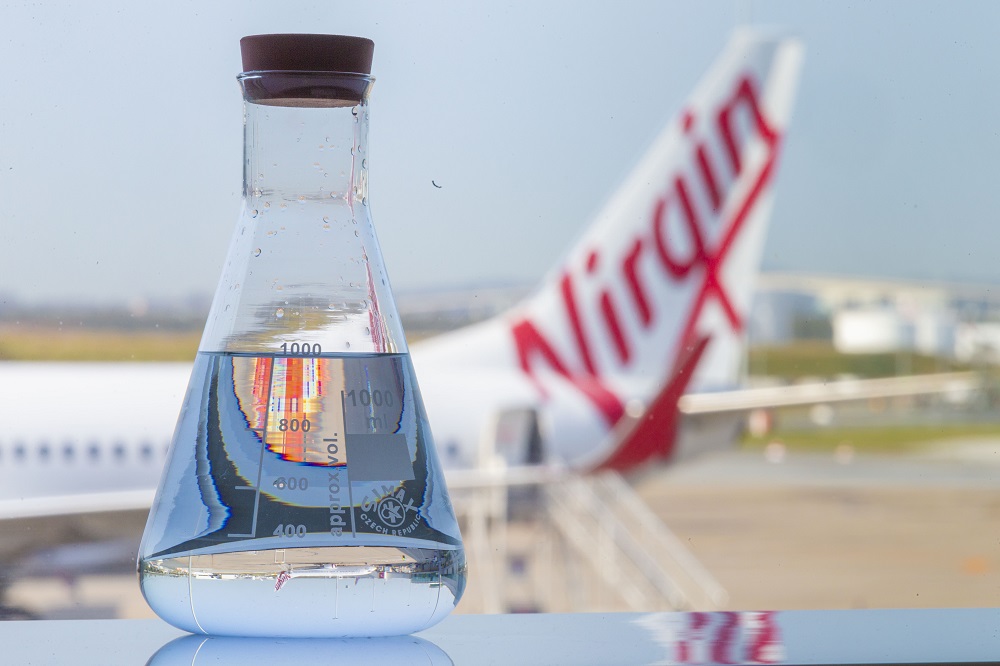

Australia has taken another step down the long road to sustainable aviation after a trial at Brisbane Airport confirmed that biofuel could be successfully delivered to aircraft through the airport’s regular fuel system.
A first for Australia, the trial involved a small amount of biofuel — some 20,000 litres — imported from the US.
It showed potential biofuel producers that their product could be successfully introduced into the Brisbane fuel system, mixed with traditional fuels and piped through to customers.
Virgin Australia announced the two-year project with the airport, US renewable fuel supplier Gevo and the Queensland Government in October, 2017, and worked on the trial with supply partners Caltex and DB Schenker.
Read: Virgin boss calls for a joint approach to Aussie biojet industry.
The first test saw a biofuel blend pumped to 195 domestic and international flights that traveled more than 430,000 kilometres.
It will be followed by additional trials over the next 12 to 18 months aimed at building up confidence and experience in the fuel supply chain.
Biofuel can be derived from a number of feedstocks available in Australia, including sugar cane bagasse, and is already in use in a handful of airports that includes Oslo and Los Angeles.
Virgin Australia general manager group sustainability Rob Wood said the trial was not about carbon savings but about supply chain readiness and education.
“Whether or not you put one litre of biofuel through or a million litres, you have to go through exactly the same rigor in terms of testing and fuel certification processes,’’ he said.
“So obviously one of the things we wanted to check was how ready was the supply chain for commercial volumes of these fuels.”
Wood said the ongoing trials, which would involve similar volumes of biofuel, were aimed at making sustainable aviation fuels part of the regular fuel process.
“If you touch it once, it’s a niche exercise, “ he said. “If you’re dealing with it regularly, you get used to that.
“So industry gets used to it, key people in the supply chain get used to it, we get a normalized testing regime for these fuels and It becomes part of the process.”
This was also important from an investment case perspective for potential biofuel facilities, Wood said.
“If you’re going to invest $300 to $300 million into a biofuel facility you need to know you can get your product to market,’’ he said.
Queensland Premier Annastacia Palaszczuk hailed the trail as another step towards a home-grown biofuels industry and Wood believes investors are out there.
The Virgin executive pointed to a global request for information Virgin and former alliance partner Air New Zealand put out two years ago for the potential production of 200 million litres of biofuel in Australia or New Zealand.
“We got very strong interest in that so I would say there definitely remains interest,’’ he said.
“Obviously, it’s an emerging industry so the first commercial-scale plants are actually based in the US and other jurisdictions that have strong policy support for those facilities.
“So policy still plays a key role in the emergence of this industry but we’re going to work actively off the back of this trail to see if we can attract investment.”
Biofuels remain a major long-term plank to the airline industry’s strategy to reduce its carbon footprint.
Airlines have proposed a four-pillar strategy to reach their goal of carbon-neutral growth from 2020 and an ambitious target of a 50 percent a reduction in net C02 emissions by 2050, relative to 2005 levels.
The International Air Transport Association said earlier this year that it wants one billion passengers to experience flights powered by a biofuel blend by 2025.
The industry is also working towards the introduction of an international carbon offset scheme as an interim solution.
Have questions or want to share your thoughts?
.jpg)